Monday, September 2, 2013


Important Dates & Reminders

*I will try to highlight new dates and information with red text.

September 4, 2013 - School Pictures at 8:45 

September 6, 2013 - Walking Field Trip to Thompson Park. Chaperons should arrive promptly for a brief virtual field trip at 9:00am. This slide show will show your role in helping our young botanists. We should return well before 11:00am. Please accept my thanks in advance to the many generous volunteers. Your contribution to this field trip (and future quarterly/seasonal trips to Thompson Park) will make this service learning project a true success.

September 11, 2013 - Early Dismissal for professional development at 1:15pm

October 8, 2013 - Ohio Reading Achievement Assessment (Please avoid scheduling appointments and absences on this date)

October 25, 2013 - End of the first quarter

October 28, 2013 - No school, teacher grading day

October 31, 2013 - Halloween party (extended lunch from 12pm till 1:30pm, most students go home to change into costumes). Please note it is district policy that no costume may include any weapons or facsimiles.

Please take a moment to visit Flyer Connection. This website will be a clearing house for non-school district flyers, including after school activities and team sports. I have made a link on the right under "Favorites" for your future reference. http://www.uaschools.org/pages/Upper_Arlington_City_SD/Community/Flyer_Connection

Fall conferences will be here before we know it. If you were unable to sign up for fall conferences during last week's Parent Information Night, please send me an email and I will let you know the remaining slots. I included a link to the slide show we presented during Parent Information Night in this week's blog post email.

 
Unfortunately, an old back injury flared up last week and I expect I will spend a few more days on the floor. I will leave detailed substitute plans and will be checking in daily until I return. I absolutely LOVE teaching and HATE being out of the classroom. My team will be keeping a close tab on our progress and ensuring that, despite my absence, we will have productive and rigorous days as well as continuing our high standards for concentration and effort. Please feel free to contact me via email if you need anything.
 

What We Learned This Week

Word Study
Students continued to study syllables, syllable types, and vowel sounds. We continued with the understanding that a syllable represents a single vowel sound (often made up of more than one vowel, aka "vowel teams") and that we break words into syllables.

This is helpful when decoding (reading unfamiliar words) and encoding (spelling words we are not secure in). I've introduced open (end in a vowel and make the long vowel sound, "vowel says its name") and closed (end in a consonant and makes the short vowel sound) syllables.

We've studied short a, e, and i sounds. This may seem very primary, but many students have not internalized this understanding. It is easy take this knowledge for granted, but explicitly studying it will pay dividends and reveal missing knowledge that will drive instruction.


Next week we will be introducing our first set of spelling generalizations. We will be focusing on short and long a vowel sounds. We will also be looking at syllable type (open, closed, vowel-consonant-e). The following words share our short and long a vowel sounds: drag (closed), cage (open), snap (closed), place (CVE), rack (closed), wax (closed), stab (closed), brake (VCE), mask (closed), space (CVE), save (CVE), change (VCCE).

As I shared at Parent Information Night, the words I send home will be representative of the generalizations we study each week. However, students will be tested on new words sharing the same generalization. In support of the Common Core, rather than relying on memorization, students will have to show they can apply what we've learned.


Reading
I concluded my first round of individual reading conferences last week with the goal of supporting student selection of "Just Right Books." We also increased our morning reading to a full 45 minutes, very impressive this early in the year. We will eventually add fifteen more minutes to read for a full 60 minutes daily. Sustained reading and Just Right Books have been shown to be two of the most meaningful reading practices a developing reader can engage in. The emphasis will be on being "real readers," readers who truly engage in their reading.

Venn Diagram by Jessica Hagy
 
Students began using Venn diagrams to compare and contrast subjects in a short passage. This requires many skills: comprehension, care in using spelling from text, underlining, looking for information. Comparing and contrasting has been identified as one of the single best ways to deepen understanding of reading. It is a skill we will continue to develop in reading, but will also use across math, science and social studies as the year progresses.

 
I've received a lot of helpful and consistent feedback regarding reading homework. As anticipated, most students are able to complete the literal front portion of the non-fiction reading quickly and accurately. We will develop our answers (using the question in the answer, answering with complete sentences, including details, avoiding pronouns, etc.) as the year progresses. However, the immediate focus is on developing comprehension with the three questions on the back.
- List three things you learned. Students who struggle with this or say, "I didn't learn anything," should record three important parts of the text.
- List three questions. Students who find this difficult should reread sentence by sentence to see if they can come up with a question for each sentence or minimally, one question per paragraph in the passage. We have worked on this and it has been modeled explicitly. However, it will continue to be a developing skill. Please continue to support your child's thinking here as it will eventually become an automatic process. If your student is really balking at this step, offer to record their questions for them. You may be amazed at how many great questions they have if they don't have to write them down. You can transition them into writing their questions by having them write one, then two, and finally three as you hand over this responsibility.
- List why you think the event was important. Help your student by relating the events in the passage to their life.

Our first read aloud is Crispin: The Cross of Lead, by Avi. Ask your student to relate what is happening in the book. Most seem to really enjoy this one. It is probably the most challenging for readers as our lives are most different from Crispin's due to the time span. We will begin to look at how Crispin's life is different than ours: shelter, clothing, food, entertainment, etc. next week.
 

Writing
We worked on editing complete sentences and learning the most common editing symbols. We also looked for sentence subjects and predicates.


Math

Students continued to review numeracy. We practiced: standard and expanded notation, making numbers, comparing numbers, naming large numbers, naming place and value, and telling time by reading an analog clock. You may want to try this with your student at home. Give them four numerals (e.g., 5, 6, 3, 2). Ask them to show the largest number they can make using only these four numerals ( 6, 532). Most can do this quickly. However, ask them to show the next largest number (6,523) and most will struggle. You can do this with the smallest value as well. If they struggle, you can have them write the numbers on index cards and move them. This helps a great deal.

Science
I introduced rocks and soil, our earth science unit. Essential learnings are: rocks are constantly forming from other rocks through different processes (erosion, heat, pressure - the rock cycle); erosion is the primary process by which rocks are formed in Ohio; rocks are made of minerals (many of which we consume when we eat fruits and vegetables); and rocks have many important uses.


Our garden has some initial sprouts. I will try to get these watered in my absence so we don't have to start over.

Saturday, August 24, 2013

Newsletter for August 23, 2013

Important Dates & Reminders

*I will try to highlight new dates and information with red text.

August 29, 2013 - Parent Information Night from 7:45pm till 8:30pm. The third grade team will be presenting together in Dr. Myers' Art Room, Room 126. Please note the change in time and location. You can sign up for fall conferences in the hallway.

September 2, 2013 - No School in honor of Labor Day

September 6, 2013 - Walking field trip to Thompson Park. More information will be shared during Parent Information Night. This field trip will support our life science, technology and service learning curricula. We will leave Windermere at 9:00am and return in time for lunch at 11:25. If you are available to chaperon, please email me. I would like to have at least seven adults.

September 11, 2013 - Early Dismissal for professional development at 1:15pm

October 8, 2013 - Ohio Reading Achievement Assessment (Please avoid scheduling appointments and absences on this date)

October 25, 2013 - End of the first quarter

October 28, 2013 - No school, teacher grading day

October 31, 2013 - Halloween party (extended lunch from 12pm till 1:30pm, most students go home to change into costumes)

What We Learned This Week

What a wonderful first week. I'm very fortunate to get to work with such a special group of students. Too, with only nineteen students I feel I've already gotten to know them much faster. We spent a lot of time this week establishing community routines and expectations. We will continue to reinforce these norms as the foundation for a learning community in the weeks to come. My emphasis will always be on catching students making good choices.

Word Study
I introduced syllables this week. Our understanding of syllables is that they represent one vowel sound, often made from multiple vowels. We practiced breaking multi syllabic and nonsense words into their syllables by saying the word, clapping the word and then writing the word. Students noticed that syllables ending in vowels usually make a long vowel sound (e.g. go) and syllables ending in consonants usually make short vowel sounds (e.g. can). The benefit of recognizing syllables and syllable types is twofold: decoding (reading unfamiliar words) and encoding (spelling words in our spoken vocabulary that we have not written before or have only used inventive spelling for). This requires a systematic review (and in some cases, introduction) to vowels and vowel sounds as well as consonants. We will do an intensive study of syllable types this year. I won't begin sending home spelling lists till the first week of September. These lists will represent the syllable type, vowel, or consonant spelling generalization we are studying that week. Students will be assessed with new words that represent the generalization we are studying. This will better represent their application than memorization of specific words. I'll discuss this in more depth at Parent Information Night.

Reading
I began individual reading conferences this week with an emphasis on choosing a just right book. It is important for young readers to have some choice in much of what they read to develop their interest and enjoyment of reading. However, it is equally, if not more, important that they be reading "just right books," (JRB) books they can read independently (a book they can read with 98% accuracy). What we may consider to be "easy" books are the perfect material for young readers and with access to libraries and the Internet students have access to JRB that are about their interests or are from their favorite genres.

Building reading stamina and self awareness of being a "real reader" (a committed reader that is focused and engaged) was a priority this week and we will extend our independent reading time up to an hour eventually (this will take some time). I will use this time daily to meet with individuals for reading conferences and word study intervention.

Reading homework focuses on two areas: reading non-fiction texts for information and comprehension. The first side supports students ability to read text for detail, a key skill in all future self directed learning. The back, optional this week, supports students ability to recall, synthesize and deeply comprehend what they are reading, all higher order reading skills. The back will not be optional beginning next week. Students, and families, desiring additional reading homework should encourage their student to read aloud nightly for approximately 20 to 30 minutes. Again, choosing a JRB is key.

Our first read aloud is Crispin: The Cross of Lead, by Avi. We will read several Avi books representing a timeline of events from the Middle Ages till the 1940's. This historical span will support our social studies curriculum, specifically understanding changes in communities over time. We will also leverage Avi to study the author's craft as students will recognize reoccurring themes and techniques. If you'd like to read more about Avi, his website is http://www.avi-writer.com/index.html. A summary of Crispin is available at http://www.avi-writer.com/books/books/crispincross.html.

 
Our first read aloud.

Students are encouraged to ask questions to support their comprehension.

 
Writing
We recorded our first writing sample of the year by writing a personal narrative about an experience from the summer. I was very pleased with most students' content. These writings serve me in getting to know the class as writers and will provide an inspiration as we look back to them to see our growth as writers. Convention is always a focus in third grade. We began working on complete sentences and will work towards mastery before moving on to the writing process, paragraphs and multi-paragraphs. Complete sentences must:
- Begin with a capital letter.
- End with a punctuation.
- Contain (or an implied) who (noun, subject).
- Contain a what (verb, predicate).
Students wrote their own sentences and we examined them for the above requirements.

Math
Numeracy will be our focus for the first month of school. I will engage students who have mastered this with problem solving, math games and Number Talks (I plan to share more about this mental math development program). This week, we studied place and value, patterns, standard notation, expanded notation and naming numbers.

34,506
standard notation
 
30,000
4,000
500
00
6
expanded notation
 

Below students are lined up, each one with a value in a place from ones to one-hundred thousands. They must offer two names. For example a student who had written 2 an was standing in the tens place would say, "twenty or two tens." This is far more complex than we might expect. Click on the video to see students in action.

 
Click on the video to see students in action.
 
Below students are playing Biggest Number, a game where they take turns rolling a ten sided die and determining where they should record their roll (in one of the 6 possible places up to the hundred thousands). Students learn to leave higher places open for higher values and to record low values in low places. Students then read their numbers to each other at the end of each game, practicing this important skill. Students who struggle with reading large numbers are encouraged to "read three numbers (between the commas) just as you would read any number up the hundreds place and then give it a last name (thousands, represented by the comma) of thousand." Most third graders are comfortable reading numbers up to the hundreds and this makes this skill less overwhelming when reading numbers up to one-hundred thousands.
 
We studied the repeating pattern of ones, tens, hundreds, one-thousands, ten-thousands, hundred-thousands.


I also conducted a benchmark fact fluency assessment of students addition and subtraction skills. If your student has not mastered these yet, please work on them at home. While some students may need to memorize specific facts, I will attempt to anchor all math facts to a strategy (e.g., sums to ten ~ on the back of this week's math homework).


Science
I enjoy beginning the year with a science experience. I find science to be a great opportunity for students to fully engage in their learning. As it is hands on and experiential, it allows all students to fully participate and develop a love for learning regardless of possible literacy challenges. We pulled all three third grade classes to introduce our physical science of force and motion. We also explored solids, liquids and gases as we added water to Alka-Seltzer to create a gas. We then went outside to launch or film canister rockets. On Tuesday, we had very little success (The bag of Alka-Seltzer had apparently gotten enough moisture in it to release the gas, but it maintained is solid state, thus it did not create enough gas to launch our rockets by building up sufficient pressure to pop the lids off.). This provided us with a wonderful learning opportunity to hypothesize, based on what we expected to happen, why the rockets failed. Having predicted the cause as a group, we tried fresh Alka-Seltzer the following day with much success. We also used a leaf blower to demonstrate Bernoulli's principle, that when air flows around an object (like an airplane wing) it speeds up creating an area of low pressure. We were able to suspend a ball over the flow of air because of the high pressure below and on the sides as gravity pushed down. We will expand on this unit in the spring.


To see Bernoulli's principle demonstrated, click on the following link: http://science.discovery.com/tv-shows/head-rush/videos/head-rush-leaf-blower-ball.htm

We also planted our classroom garden of carrots, chamomile, spearmint, oregano and basil. In conjunction with our Social Studies study of the feudal and agrarian systems of the Middle Ages, we planted like our early ancestors. We will observe changes and compare and contrast the plants we grow until we can collect them and celebrate our garden with a small meal featuring our harvest. We watched a short brainpop video on seed plants.


Social Studies
We began studying the Middle Ages, specifically the feudal system to see an earlier and contrasting form of self government from our democratic system. I will elaborate on this as the year progresses and we study other forms of government through Avi's books and our government unit on the three branches and local government.

Friday, August 9, 2013

Homework How To's

Homework Philosophy & Practices


Homework can be a challenge for every family and as students enter third grade, the homework expectations increase. This post is intended to give families and students an ideas of what to expect for third grade homework. This post will also provide you with a reference to refer to throughout the year. I will discuss homework at the Parent Information Night as well. As each student is unique, this information may not reflect your student's homework as I will try to differentiate it to make it as beneficial as possible.

Homework has changed significantly over the years, both in purpose and amount. I strongly support the research based recommendations of 3rd graders having regular homework to primarily develop  positive time management and work habits, rather than to learn new material (which will become the focus in later years). (Students doing additional or individualized homework for intervention and support will be learning new skills.) I also support the recommendations of approximately 10 minutes of homework per grade level. However, as the school year begins and students return from summer, homework can take considerably longer than this until they get back into the swing of things or develop important skills. Seeing this through, as hard as it can be, is important for students' success and will make future homework much easier for them.


Some students may need modified homework depending on the current academic levels. Please communicate with me if you find your student's work is simply too hard or too much and I will work with you to support them. They may need modified homework or simply modified practices, e.g., a quiet environment to complete it or change in routine.


It is important to note that students who are currently performing below grade level, will indeed need to do additional work at home to help close any academic gaps. Doing the same amount as their peers simply will not provide enough practice to catch up. The hard work they do now, will pay off later. However, overwhelming students who already feel behind is not productive either. I am happy to partner with families to develop strategies for accomplishing an increased workload and to help your student understand this as they often, understandably, are frustrated by this fact and may even feel it is unfair. I will stress that while we work and learn together in a community, it is important to me that I know each student as an individual and am able to support them based on their individual needs. Same or equal is not always fair.


I do not grade homework in the traditional sense as it is often not done independently, but I do check to ensure it has been attempted and do communicate with families if it is not turned in regularly or if it is not done correctly. I will attempt to email you to let you know your student has not returned their homework. However, our days are full and I may not get to this task every day.


Homework habits are important to your student's success as well. Most research (and parents) find their students are more successful when they have clear, predictable, and routine homework habits. This can be hard these days as many of our children are very busy with additional activities such as sports and social organizations after school. I recommend:
- Consistent routine: Your student may do better to come straight home and finish their homework, or they may need a break and a snack. You know your student best. The goal is to aim for consistency.
- Place: Your student will do best with few distractions (e.g., away from electronics, pets, and siblings) in a quiet environment. You may even plan to take them to the library after school to do their homework.
- Time management: Your student should develop a sense of how they spend their time when they are "working." My own two students are vastly different. One will knock out their homework with concentrated effort in ten to twenty minutes. The other had to overcome a habit of balking at their work longer than the actual work took. I simply timed their on and off task work and shared it with them once they were done. This can be difficult. I know from personal experience. There are no magic short cuts. My only advice is to stick to it and feel free to involve me in discussions with your student to reinforce that this is work I've assigned and its purpose. This can help alleviate any homework fights you may endure.
- Independence: I will explicitly model my homework expectations and strategies and expect your student to attempt it on their own. Let them try before you jump in to help or they may become dependent. However, if your student is struggling, please let me know and I can make modifications. 

Nightly Homework - What To Expect

Students will receive homework Monday through Thursday. I do not assign weekend homework. Homework is always due the following day. I find it is easier for students and families to manage nightly homework than packets, which can get pushed till the end of the week for a long night of homework, which defeats the purpose of developing good work habits and time management.


Word Study: Once the school year has gotten under way, your student will be assigned specific spelling words (and more importantly, patterns) to practice nightly. We will not start spelling for the first few weeks of school as I will be assessing students developmental spelling levels during this time to determine their needs. I will share specific strategies to help your student practice these patterns in the blog. Here are several choices to help your student stay interested, as well as utilizing multiple methods of accessing the same learning.
- See it, say it, spell it (three times for each word ensuring practicing correct spelling)
- Sort by pattern
- Write additional words with the same patterns
- Write the words in alphabetical order
- Count syllables
- Use words in sentences
- Word ladders
- Identify parts of speech, often multiple
- Practice lists of words: colors, days of the week, months, holidays, states, countries, etc.
- Keep a list of words you miss to practice
- Family spelling bee
- Research word origins
- Have fun with palindromes (e.g., never odd or even)
- Introduce a new vocabulary word or idiom each night at dinner and see who can use it correctly most often.


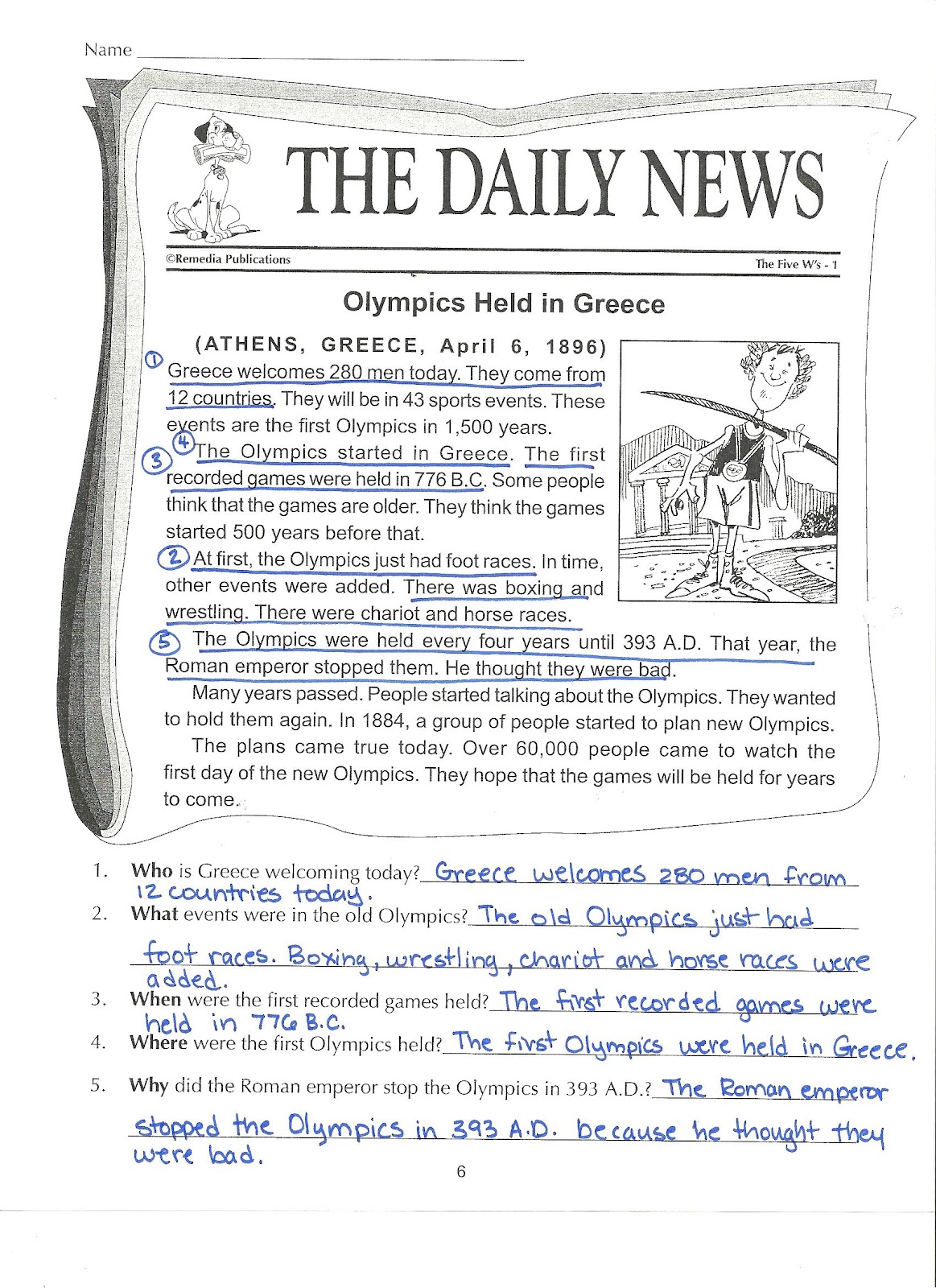
Reading: I love to read! I read fiction and non-fiction, from biographies and history to fantasy and science fiction. I will try to share my love of reading for pleasure and we will develop many deep thinking reading skills at school, but my homework focus will be on reading for information, the primary reading activity your student will have as they continue through their education. To start the year, your student will receive a one page reading and response passage, The Daily News, nightly. I've provided a sample below to show you what these look like and how I expect them to be completed (although I suggest pencil). The backside includes an optional set of more complex comprehension questions to deepen student understanding. The first week's homework goal is simply to get students into a routine and I will accept most homework regardless of the skills demonstrated.

 Nightly Reading Homework Sample

I will work hard to identify students' reading levels as quickly as possible, but will start the year assigning everyone the same homework.

As they year progresses and students' master this important skill set, I will assign even more challenging homework that pushes them to think beyond the literal and make connections to what they are reading.
 
Math: Math instruction has probably changed more than any other academic area since most of us were in school. Where we learned algorithms and memorized linear math, today's students are taught to truly understand math and problem solve using a variety of possible strategies to arrive at a single common answer. Your student's math homework will review common linear concepts and support fact fluency. Your student's familiarity with these more basic concepts will support their ability to do far more complex math at school. The front of their homework will be a Drop In The Bucket review sheet (see  below).


Nightly Math Homework Sample

The back of their math homework will be a series of addition (later multiplication) facts based on strategies. These strategies, which I will share explicitly on the blog as I introduce them, will be your student's anchor to recalling or quickly solving these facts. It provides them with a way of organizing facts into groups (e.g., spelling patterns) without having to memorize 100 seemingly independent math operations.

Nightly Math Fact Fluency Sample

I will discuss multi digit operations at our Parent Information Night. Please hold off on teaching your student traditional algorithms until we've had a chance to discuss these.

Keyboarding: Keyboarding is becoming an indispensable skill for all students, especially for those with fine motor challenges. Future assessments will be taken solely on computers and students' ability to concentrate on their composition and operations, rather than hunting for the appropriate key will make a significant difference in how they perform. Our 3rd grade team is working hard to collaborate on ways to provide frequent and consistent keyboard practice. However, with so little time in the day, your student will greatly benefit from five to ten minutes of keyboard practice at home. I will share how they can download great free software to use at home at our upcoming Parent Information Night. In the mean time, students can try Dance Mat Typing, a free online typing instructional program from the BBC. http://www.bbc.co.uk/schools/typing/


Challenge Homework

Many families request additional or "challenge" homework for their students.  Here are some suggestions for families who desire more, and more importantly, differentiated work.


Reading for enjoyment with your student develops a joy for reading as well as showing them you value reading. Students can respond to their reading by journaling or discussing. There are no limitations. A former student used to make Lego movies of his favorite scenes from books. Students who struggle with reading may enjoy reading harder texts along with a book on CD. Our Windermere library and all of the Upper Arlington library branches will be happy to help you match books with CDs.


I want to share a wonderful reading resource, RAZ-Kids, for your student that either wants or needs additional support. Again, I can not overstate the fact that students who are behind need to do additional work to close performance gaps. RAZ-Kids is a great resource to do additional nightly, weekend and holiday reading. Please visit: http://www.raz-kids.com/main/Login Once on this page, you can login using the following password: jhudsonn

Your student can click on their name and they will be redirected to their home page. Please explore this page with your student to learn more about the many options they have. The page will offer at-level texts specifically chosen for your reader's needs. I have made initial assignments based on your student's end of year Developmental Reading Assessment (DRA) score. (If I do not have DRA scores I assigned your student a level 28, on grade level end of 2nd grade.) It also offers assessments and even a reader so your student can listen and follow along. There are fiction and non-fiction texts, as well as core curriculum science and social studies links as well. It's a great resource. Many students have had direct experience with this site at school. No alignment is perfect and some students may have a too easy or too challenging text level. Please let me know if the text is too difficult. I will be able to adjust and monitor student progress. I would recommend reading one story per night on school nights. I am very comfortable assigning your student additional reading if this makes this otherwise optional homework less of a fight for you at home.


Writing: Students can write for many different purposes. Letters to family or finding a pen pal, especially from a different culture, can be very rewarding, particularly in our time of emails, texts and tweets. Research can be a great way to link reading and writing and it allows your student to pursue their interests, which increases commitment. Many students like to write their own fiction, which can be very challenging, but interesting work. I've had a number of students write plays based on books they've read, a great way to start writing without being overwhelmed. I'm very fond of Keri Smith's books for reluctant writers to develop a purpose for writing.


Math: Students can always practice math facts to develop proficiency, but you may want to focus on problem solving, simply starting with creating your own story problems. I advocate using the
part + part = whole
model where students have to first identify the missing addend or factor before solving the problem. Construction projects and science experiments provide great opportunities for utilizing math in meaningful ways.

I will share websites you may want to visit at our Parent Information Night.


Ohio Department of Education: Families that want to get a better idea of the types of testing their student will experience this year can visit the ODE's website and view previously administered 3rd grade reading and math assessments.
http://education.ohio.gov/GD/Templates/Pages/ODE/ODEDetail.aspx?page=3&TopicRelationID=240&ContentID=4348&Content=126215

Sick & Vacation Homework

I do not assign homework for students who are ill or take planned absences during the school year. If a child is ill I want them to rest, recover and rejoin us as soon as possible. For those who are travelling, I do encourage them to read for enjoyment, practice math facts and journal about their adventures. I do not hold them responsible for missed homework.

Special Areas

A Days - Art      9:45-11:05

B Days - Music 1:40-2:15
             - PE      2:15-2:50

C Days - PE      2:15-2:50

D Days - Music 2:15-2:50

Library dates will be posted on our classroom blog under important dates and reminders as soon as I know the schedule.

We do not have specials on the first or last days of school. Your student will need athletic shoes on all gym days and should plan to leave an art smock in their locker.

First Semester (click to enlarge)
 
Second Semester (click to enlarge)

Welcome to Room 120 for 2013-2014


Welcome to Room 120 for the 2013-2014 school year. (If you have received a postcard in the mail you will be in Room 120 with Mr. Hudson this year.) I hope you've had a great summer and are as excited to start as I am! We have a lot of new faces in the building this year and we're all very excited. Please welcome our new principal, Ms. Julie Nolan.


Please plan to introduce yourself at our upcoming Back To School Night (see below for date and time). I'm looking forward to seeing you. I will have some important forms for you and your family and they can sign up for fall conferences.

You have a little homework before school starts. Please choose a book to bring on our first day that you would like to start or continue reading.  It is VERY important that this be a book you can read fluently (your reading voice sounds like your normal, natural speaking voice) and understand. Your only other homework is to bring lots of questions and prepare to try and persevere!


Important Dates & Reminders
August 14, 2013 - New Family & Kindergarten Ice Cream Social at 7pm in the courtyard.
August 16, 2013 - PTO Supply Sale in the Multipurpose Room from 10 till 12.
August 17, 2013 - PTO Supply Sale in the Multipurpose Room from 10 till 12.
August 19, 2013 - Meet Your Teacher Night from 4pm till 5pm in Room 120.
August 20, 2013 - First day of school:)
August 29, 2013 - Parent Information Night from 7:00pm till 9:00pm in Room 120 (more details to come).

September 2, 2013 - No School in honor of Labor Day
September 11, 2013 - Early Dismissal for professional development at 1:15pm

October 8, 2013 - Ohio Reading Achievement Assessment (Please avoid scheduling absences on this date)
October 25, 2013 - End of the first quarter
October 28, 2013 - No school, teacher grading day
October 31, 2013 - Halloween party (extended lunch from 12pm till 1:30pm, most students go home to change into costumes)

Sunday, May 26, 2013

Final Newsletter of the Year

Dear Families,
 
This will be the final newsletter of the year. I cannot adequately express how grateful I am to work with your students. This has been a fantastic year, full of learning and growth for all, including me. I look forward to following your student's progress over the coming years and seeing the many friendly faces in the Windermere community. I hope everyone has a safe, fun and enriching summer. It has been a real pleasure to serve your family this year.

Important Dates and Reminders

 
Windermere celebrated the retirement of our principal, Mr. Steve Scarpitti. After 35 years of serving students, families and staff Mr. Scarpitti is retiring. He has touched so many in our community as a teacher, mentor and friend. He will be missed and has left an indelible legacy at Windermere and throughout Upper Arlington. Good luck with retirement "Scarpy!"
 

From the cafeteria...
"Beginning Monday, May 13th, if your child has a negative lunch balance and wants to buy a lunch, he/she will be served a cheese sandwich, fruit or vegetable and a milk for the regular cost of a hot plate lunch ($2.75)."


All library materials are due Wednesday, May 29th. Students must either return or pay for missing library materials before they can receive their final progress report. Please contact Mrs. Hastings for replacement costs at khastings@uaschools.org. The Uppper Arlington Public Library will be here next week to share their summer reading program. With three branches they are easily accessible and offer many interesting opportunities.
 
 
Our remaining Walking Wednesdays is May 29th.
 
 
May 29, 2013: Field Days
Please contact Mr. Moore if you are able to volunteer at adammoore@uaschools.org.
Apply sunscreen before students arrive.
Send water bottles with name on it.
Wear a hat.
Wear a swimsuit under athletic clothing.
Wear old running shoes. Crocs and flip flops are not suitable for Field Day.
I'll be passing out moustaches for "Team Hudson" and will try to get a team photo in the morning.

 
I will be showing Fantastic Mr. Fox on the last days of school to celebrate our hard work. This Roald Dahl classic will be our final read aloud of the year. Permission slips for viewing the film will be sent home this week. Please return them by Friday, May 31st.

I'd like to thank all of the volunteers who have helped our class throughout the school year, including the end of year party. The camping theme is right up my alley. From field trips to science experiments, I could not have done it without your help. Thank you to the Jack family for their generous donation of delicious Panzera's pizza for our last day of school!
 
What We Learned This Week
 
 
Research
Students have nearly completed their animal research. They have used Venn diagrams to compare and contrast two animals across: classification, life cycle, habitat, food web, and adaptations/defense mechanisms. This has been challenging for students and has taken them far beyond the traditional animal research report. Students used non-fiction informational texts that have supported our understanding of non-fiction text features (table of contents, index, text boxes, charts, graphs, etc.) Students also utilized iPads to research questions they developed throughout their research and missing information they were unable to find in their books. Finally students are constructing summary statements for each Venn diagram that shares what their animals have in common and how they contrast. I used many different hands on experiences to immerse students in classification and food web. This has been challenging but infinitely rewarding to watch.

Reading
During the last two weeks I assessed each student using the Developmental Reading Assessment (DRA), Reading A to Z leveled books, RCBM and MAZE to determine their independent fluency and comprehension levels in fiction and non-fiction.

Writing
Students completed their final writing for me, a "survival guide" for third grade in the form of a friendly letter addressed to next year's third graders. The class as a whole have really progressed in their writing. I learn a lot from students about my teaching as well as they share their observations on what they enjoyed most, what was hardest and advice for "surviving" third grade. Science is usually a big hit with students while homework is often seen as "a lot more." There is NO homework for the remaining days of school. I will compile their observations and suggestions into a single letter that will greet next year's class.

Math
We reviewed all priority mathematics concepts and assessed student knowledge this week as well.

Have a great summer! Gone pickin' :)
 

Friday, May 10, 2013

Newsletter for May 10, 2013

Thank you for the kind gifts this week. I appreciate the idea of teacher appreciation week, but I feel honored to work with your students daily.

Important Dates and Reminders

Our field trip was postponed. We're waiting to hear back from Tremont as they must schedule buses with the district. Hopefully we will be able to reschedule.

From the cafeteria...
"Beginning Monday, May 13th, if your child has a negative lunch balance and wants to buy a lunch, he/she will be served a cheese sandwich, fruit or vegetable and a milk for the regular cost of a hot plate lunch ($2.75)."

From Mrs. Dobies...
"The Wish Run is tomorrow, Saturday, May 11th! It's not too late to join the fun! Registration begins at 8:00 am in front of the school. Student Council members have worked especially hard to make this year's event a success. All proceeds go to Nationwide Children's Hospital. If you have already registered, thank you! Please remember that Wish Run T-shirts go to the first 100 5K participants to check in on race day. Hope to see you at the Wish Run!"


Our remaining library days are May 14th and 29th.

Our remaining Walking Wednesdays are: May 1, 8, 15, 22, and 29.

May 11, 2013: Windermere Wish Run
May 27, 2013: No School: Memorial Day
May 28, 2013: No school for students: Teacher safety in-service

May 29, 2013: Field Days (Please contact Mr. Moore if you are able to volunteer at adammoore@uaschools.org.)