Friday, May 16, 2014
Important Dates for May 16, 2014
Important Dates & Reminders
*I will try to highlight new dates and information with red text.
May 12 -19, 2014: Shoe Drive! Please send in your slightly used shoes to Mrs. Meyer's (Grade 4) or Mrs. Dobies' (Grade 2) classroom. The Shoe Drive benefits the Ashe Foundation, an organization that gathers and distributes shoes to aid the disadvantaged and underprivileged children of African nations.
May 19 - 20, 2014: Terra Nova Reading and Language Arts and Mathematics Assessments. Please avoid appointments and absences.
May 20, 21, and 22, 2014: We will eat in the classroom due to the 5th Grade Musical. Please do not pack any tree nuts or peanuts in student lunches.
May 21, 2014: All library materials are due. Please contact Mrs. Hastings at khastings@uaschools.org if you cannot find a lost library item so she can tell you the replacement cost.
May 23, 2014: Invention Convention Display Boards (or posters) due
May 26, 2014: No school: Memorial Day
June 2, 2014: Field Day: Please send your student with old tennis shoes (no flip-flops or Crocs), a swimsuit under athletic clothing (they will get wet), a change of clothes, a towel, sunscreen, and a water bottle.
June 3, 2014: Field Day Rain Date
June 3, 2014: Invention Convention Prototypes due (see below under science)
June 3, 2014: Invention Convention in cafeteria from 10:15 till 11:00. See the Invention Convention Post from earlier this week.
June 4, 2014: Last day for students
June 5, 2014: Teacher Grading Day
Friday, May 9, 2014
Thank You and important dates for May 9, 2014

Thank you for all of the thoughtful gifts this week. I feel very appreciated. In fact I feel I should thank you for the opportunity to serve your students and our wonderful community!

I'm just sharing important dates below, but I'd like to also share a link of the International Space Station's (ISS) live streaming: http://spacestationlive.nasa.gov/timeline/ This is a really neat bird's eye view of the Earth from the ISS and you can listen to the astronauts and scientists discussing research and maintenance.
Homework
Next week will be the last week of typical homework. The Invention Convention display board and prototype will serve as homework the last two weeks of May.
Important Dates & Reminders
*I will try to highlight new dates and information with red text.
May 12 -19, 2014: Shoe Drive! Please send in your slightly used shoes to Mrs. Meyer's (Grade 4) or Mrs. Dobies' (Grade 2) classroom. The Shoe Drive benefits the Ashe Foundation, an organization that gathers and distributes shoes to aid the disadvantaged and underprivileged children of African nations.
May 12, 2014: InView assessment. Please avoid appointments and absences.
May 13 - 14, 2014: Terra Nova Reading and Language Arts and Mathematics Assessments. Please avoid appointments and absences.
May 14, 2014: Early Release at 1:15 for professional development
May 20, 21, and 22, 2014: We will eat in the classroom due to the 5th Grade Musical. Please do not pack any tree nuts or peanuts in student lunches.
May 21, 2014: All library materials are due. Please contact Mrs. Hastings at khastings@uaschools.org if you cannot find a lost library item so she can tell you the replacement cost.
May 23, 2014: Invention Convention Display Boards (or posters) due
May 26, 2014: No school: Memorial Day
June 2, 2014: Field Day: Please send your student with old tennis shoes (no flip-flops or Crocs), a swimsuit under athletic clothing (they will get wet), a change of clothes, a towel, sunscreen, and a water bottle.
June 3, 2014: Field Day Rain Date
June 3, 2014: Invention Convention Prototypes due (see below under science)
June 3, 2014: Invention Convention in cafeteria from 10:15 till 11:00. See the Invention Convention Post from earlier this week.
June 4, 2014: Last day for students
June 5, 2014: Teacher Grading Day

Wednesday, May 7, 2014
Invention Convention
INVENTION CONVENTION TIME

All students will be participating in Windermere's Invention Convention. Students will identify a problem and develop an invention to solve their problem.
Student Journal
Students viewed a slide show of problems and inventively simple solutions to get them thinking. They should have completed the first page of their student journal by this Friday, May 9th. Coming up with three unrelated problems will give them plenty to work with next week. They will use technology to research their problem and solution.
Students will complete their journal at school to document their process, from identifying their problem to building a prototype. Student journals will be finished and sent home Friday, May 16th in order to give plenty of time to complete their display boards. Please don't let your student lose their journal or they will be significantly behind.
Display Boards
Display boards are due May 23rd. I will send home a paper copy of the display board requirements (click below) with student journals on May 16th. Display boards will be constructed at home as homework. Tri-fold display boards may be purchased at United Art & Education, 3622 Fishinger Blvd. You may use poster board, but it should include all of the following information as well.

(click to enlarge)
This was sent home on a green sheet of paper, separate from the student journal.
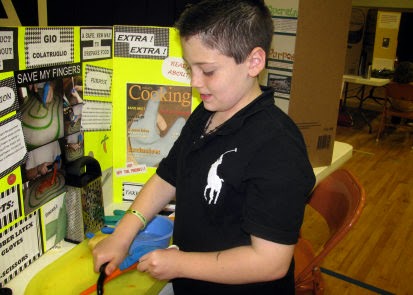
Here are several display board examples: While these don't follow all of the requirements for the board above, they will give you and your student some ideas. I have shared many different examples with your student so they should be familiar with this step. You can probably help most by having them plan and do a little work daily so they don't have to cram the night before their board is due. Anything on their board should be securely attached so it won't fall off.



Prototype
Students will build a representative (does not have to be a fully operational) prototype. These will be due on June 2nd. Prototypes must be no larger than a paper box (approximately 20" x 12" x 12") and may not use electricity (except for batteries). Prototypes will be constructed at home as homework.
Convention
Students will present their journal, display board, and prototype the morning of June 3rd.
Important: If we have to switch Field Day, currently scheduled for Monday, June 2nd, due to rain, we will host the Invention Convention on Monday, June 2nd, instead of Tuesday June 3rd.
Students will assess each other's inventions from 9:00am till 10:00am. Parents are invited to come from 10:15 till 11:00. You are welcome to take your student out for a celebratory lunch. Students who are unable to go out for lunch will watch a movie during lunch in my classroom to celebrate (I don't want anyone to feel left out).
Help
The most common question I receive is, "How much should parents help?"
This is NOT parent work. You may help your student by encouraging them to think about and complete their at school work. You can even help them assemble their boards and prototypes, but students must be able to explain their work and demonstrate understanding of every step of the process. We are not looking for robots or technologically bound solutions, but simple and achievable solutions to problems that impact many people. The real benefit of this project is the student learning. We want our future to see they can identify and solve others' problems. In the spirit of the Ugandan Water Project, the inspiration for this year's Wish Run, we want our students to take full advantage of the privileges we have in our community to help others.
Friday, May 2, 2014
Newsletter for May 2, 2014
April showers bring May flowers!

Important Dates & Reminders
*I will try to highlight new dates and information with red text.
May 6, 2014: Voting day - Please do not pack any peanut products in lunches as students will be eating in the classroom.
May 6, 2014: 3rd Grade Reading Ohio Achievement Assessment for all students. Please avoid appointments and absences.
May 7, 2014: 3rd Grade Mathematics Ohio Achievement Assessment for all students. Please avoid appointments and absences.

May 8, 2014: Parent Information Meeting for Girls On The Run program. Contact Ann Carmichael for more information on this great program at anncarmichael2@gmail.com

May 9, 2014: Students' Invention Convention problems due. (See below under science)
May 10, 2014: Windermere Wish Run for the Ugandan Water Project
You can register at https://www.premierraces.com/viewevent.asp?eventID=1054
May 12, 2014: InView assessment. Please avoid appointments and absences.
May 13 - 14, 2014: Terra Nova Reading and Language Arts and Mathematics Assessments. Please avoid appointments and absences.
May 14, 2014: Early Release at 1:15 for professional development
May 20, 21, and 22, 2014: We will eat in the classroom due to the 5th Grade Musical. Please do not pack any tree nuts or peanuts in student lunches.
May 21, 2014: All library materials are due. Please contact Mrs. Hastings at khastings@uaschools.org if you cannot find a lost library item so she can tell you the replacement cost.
May 23, 2014: Invention Convention Display Boards (or posters) due (see below under science)
May 26, 2014: No school: Memorial Day
June 2, 2014: Field Day
June 3, 2014: Field Day Rain Date
June 3, 2014: Invention Convention Prototypes due (see below under science)
June 4, 2014: Last day for students
June 5, 2014: Teacher Grading Day
What We Learned This Week
Word Study
We had a busy week in word study. We reviewed many key Common Core standards:
- Synonyms and antonyms
- Contractions
- Prefixes and Suffixes
- Subject and predicate
- Parts of speech (nouns, verbs and adjectives)

Reading
I continue to meet with students in individual reading groups and we focus on their individual reading goals and corresponding strategies. Many students have progressed to the role of playwright where they must choose a favorite scene from a recently completed chapter book and turn it into a play. They must create a character for their narrator who introduces the play and provides important background knowledge. They must then write dialogue for all of their characters. Playwrights type their plays and choose actors and finally present their play to the class after a few rehearsals which focus on projection and expression (in lieu of costumes, props and background).

We began our final research project for the year. Each student will use multiple sources to compare and contrast two animals across key research elements of:
- Classification
- Habitat
- Food web
- Adaptations
- Life cycle
Students must take notes using Venn diagrams for each of these areas. They will also use technology to complete their research.
Writing
Students are taking notes for their animal research projects and synthesizing them into their own words to produce a written report.
Math
Students reviewed data and measurement (pictographs, bar graphs, line plots, showing time on an analog clock). We also reviewed multiple strategies for determining area and perimeter. Finally, we worked on fractions. Students' ability to fluently work with fractions is dependent upon their mastery of multiplication and division facts. Students simplified fractions and converted improper fractions into mixed number fractions and vice versa.

Science
In conjunction with our animal research literacy study, we are exploring them in further through our life science study. Students will learn through hands-on lessons on each of the study areas: classification, habitat, food web, adaptations, and life cycle. Our research explorations will be driven by our essential question: "How do animals' adaptations help them survive in their habitat?" Students' understanding will be demonstrated with a "scranimal" (scrambled animal). They will be given a randomly determined habitat and will have to determine which of their two animals' adaptations would best serve them in their habitat to create a new animal.

All students will be participating in Windermere's Invention Convention. Students will identify a problem and will develop an invention to solve their problem. We viewed a slide show of problems and inventively simple solutions to get them thinking. Please help your student think about problems you routinely have at home or during family activities. This is the first page of your student's invention convention journal. These are due May 9th. There will not be any other homework next week. Hopefully students will enjoy this work. They should come up with three unrelated problems to give them plenty to work with the following week.
They will use technology to research their problem and solution. Students will complete a journal at school that documents their process from identifying their problem to building a prototype.
They will also be required to create a display board, due May 23rd. I will send home explicit directions on the minimum requirements for a display board or poster after students complete their journals. Display boards will be constructed at home as homework.
Students will build a representative (does not have to be a fully operational) prototype. These will be due on June 3rd. Prototypes must be no larger than a paper box (approximately 20" x 12" x 12") and may not use electricity (except for batteries). Prototypes will be constructed at home as homework.
Important Dates & Reminders
*I will try to highlight new dates and information with red text.
May 6, 2014: Voting day - Please do not pack any peanut products in lunches as students will be eating in the classroom.
May 6, 2014: 3rd Grade Reading Ohio Achievement Assessment for all students. Please avoid appointments and absences.
May 7, 2014: 3rd Grade Mathematics Ohio Achievement Assessment for all students. Please avoid appointments and absences.
May 8, 2014: Parent Information Meeting for Girls On The Run program. Contact Ann Carmichael for more information on this great program at anncarmichael2@gmail.com
May 9, 2014: Students' Invention Convention problems due. (See below under science)
May 10, 2014: Windermere Wish Run for the Ugandan Water Project
You can register at https://www.premierraces.com/viewevent.asp?eventID=1054
May 12, 2014: InView assessment. Please avoid appointments and absences.
May 13 - 14, 2014: Terra Nova Reading and Language Arts and Mathematics Assessments. Please avoid appointments and absences.
May 14, 2014: Early Release at 1:15 for professional development
May 20, 21, and 22, 2014: We will eat in the classroom due to the 5th Grade Musical. Please do not pack any tree nuts or peanuts in student lunches.
May 21, 2014: All library materials are due. Please contact Mrs. Hastings at khastings@uaschools.org if you cannot find a lost library item so she can tell you the replacement cost.
May 23, 2014: Invention Convention Display Boards (or posters) due (see below under science)
May 26, 2014: No school: Memorial Day
June 2, 2014: Field Day
June 3, 2014: Field Day Rain Date
June 3, 2014: Invention Convention Prototypes due (see below under science)
June 4, 2014: Last day for students
June 5, 2014: Teacher Grading Day
What We Learned This Week
Word Study
We had a busy week in word study. We reviewed many key Common Core standards:
- Synonyms and antonyms
- Contractions
- Prefixes and Suffixes
- Subject and predicate
- Parts of speech (nouns, verbs and adjectives)
Reading
I continue to meet with students in individual reading groups and we focus on their individual reading goals and corresponding strategies. Many students have progressed to the role of playwright where they must choose a favorite scene from a recently completed chapter book and turn it into a play. They must create a character for their narrator who introduces the play and provides important background knowledge. They must then write dialogue for all of their characters. Playwrights type their plays and choose actors and finally present their play to the class after a few rehearsals which focus on projection and expression (in lieu of costumes, props and background).
We began our final research project for the year. Each student will use multiple sources to compare and contrast two animals across key research elements of:
- Classification
- Habitat
- Food web
- Adaptations
- Life cycle
Students must take notes using Venn diagrams for each of these areas. They will also use technology to complete their research.
Writing
Students are taking notes for their animal research projects and synthesizing them into their own words to produce a written report.
Math
Students reviewed data and measurement (pictographs, bar graphs, line plots, showing time on an analog clock). We also reviewed multiple strategies for determining area and perimeter. Finally, we worked on fractions. Students' ability to fluently work with fractions is dependent upon their mastery of multiplication and division facts. Students simplified fractions and converted improper fractions into mixed number fractions and vice versa.
Science
In conjunction with our animal research literacy study, we are exploring them in further through our life science study. Students will learn through hands-on lessons on each of the study areas: classification, habitat, food web, adaptations, and life cycle. Our research explorations will be driven by our essential question: "How do animals' adaptations help them survive in their habitat?" Students' understanding will be demonstrated with a "scranimal" (scrambled animal). They will be given a randomly determined habitat and will have to determine which of their two animals' adaptations would best serve them in their habitat to create a new animal.
All students will be participating in Windermere's Invention Convention. Students will identify a problem and will develop an invention to solve their problem. We viewed a slide show of problems and inventively simple solutions to get them thinking. Please help your student think about problems you routinely have at home or during family activities. This is the first page of your student's invention convention journal. These are due May 9th. There will not be any other homework next week. Hopefully students will enjoy this work. They should come up with three unrelated problems to give them plenty to work with the following week.
They will use technology to research their problem and solution. Students will complete a journal at school that documents their process from identifying their problem to building a prototype.
They will also be required to create a display board, due May 23rd. I will send home explicit directions on the minimum requirements for a display board or poster after students complete their journals. Display boards will be constructed at home as homework.
Students will build a representative (does not have to be a fully operational) prototype. These will be due on June 3rd. Prototypes must be no larger than a paper box (approximately 20" x 12" x 12") and may not use electricity (except for batteries). Prototypes will be constructed at home as homework.
Friday, April 25, 2014
Newsletter for April 25, 2014
Important Dates & Reminders
*I will try to highlight new dates and information with red text.

April 25, 2014: Kid Fest 5:00 till 8:00pm (Rain or shine!)
May 6, 2014: 3rd Grade Reading Ohio Achievement Assessment for all students. Please avoid appointments and absences.
May 7, 2014: 3rd Grade Mathematics Ohio Achievement Assessment for all students. Please avoid appointments and absences.
May 10, 2014: Windermere Wish Run for the Ugandan Water Project
You can register at https://www.premierraces.com/viewevent.asp?eventID=1054
May 14, 2014: Early Release at 1:15 for professional development
May 26, 2014: No school: Memorial Day
June 2, 2014: Field Day
June 3, 2014: Field Day Rain Date
June 4, 2014: Last day for students
June 5, 2014: Teacher Grading Day
What We Learned This Week
Word Study
We studied verb tenses (past, present, and future) this week. Students learned how to determine the appropriate form of a verb using context clues. Students also learned generalizations for spelling the present and past tenses of verbs:
- Many verbs simply add -s to the end to become present tense (e.g., walk becomes walks).
- Verbs that add a syllable when they become present tense end in -es (e.g., crunch becomes crunches).- Present tense verbs ending in a consonant and -y change to -ies (e.g., fly becomes flies).
- Verbs ending in a short vowel sound and a consonant double the consonant for past and present tense (e.g., flip becomes flipped or flipping).
- Students studied many irregular past tense verbs (e.g., teach becomes taught).
Students reviewed contractions and the use of the apostrophe as a place holder for the missing letters when two words are combined. We composed contractions (e.g., can not becomes can't) and decomposed contractions (e.g., can't becomes can not).
We reviewed that synonyms mean "same" and antonyms mean "opposite." We rely on the rhyme between "synonym - same" and "antonym - opposite" as well as sign language to help us remember this. See if your student can share their respective signs. You can play Synonym Says with them or see if they can generate a longer list of synonyms and/or antonyms for common words such as "big" at the dinner table.
Reading
Students learned how to organize responses to non-fiction texts. It is a challenge for many third graders to provide two contrasts for a reading selection. If asked to provide to contrasts between cats and dogs, most students will list only one and provide both sides (e.g., cats live on land and fish live in the water) or they will list two contrasts, but only for one idea (e.g., cats live on land, fish have scales) without providing the other subject's contrasting point.

We are studying Brer Rabbit Tales and Aesop's Fables to develop the ability to determine the message or lesson implied in a fiction story, a primary purpose of folk tales.

We recently started reading The Hobbit by J.R.R. Tolkien. This dovetails nicely with our first fiction writings.
Writing
 Students began writing their first fiction fantasy pieces. These are short single paragraphs that respond to a topic sentence and an image such as the one above. Fiction is much harder to write because the author must anticipate the reader's questions and fill in any gaps. Non-fiction narratives, persuasive essays, and research are more about organization as all of the information is potentially there. I'm using great images and text from Chris Van Allsburg's book, The Mysteries of Harris Burdick. These provide enough of a starting point for students but leave a lot to start with. We share our ideas and compare them to the stories that a host of well known authors have contributed to Van Allsburg's images.
Math
We explored two step story problems. We began by determining all of the sixteen possible operations combinations we could have in a two step problem (I encourage students to use sum and difference instead of plus and minus):
sum sum, sum difference, sum multiplication, sum division
difference sum, difference difference, difference multiplication, difference division
multiplication sum, multiplication difference, multiplication multiplication, multiplication division
division sum, division difference, division multiplication, division division
I find this helps them to guess less often and really look at the questions closely to determine which two operations they need to do.
We concluded (but will continue to practice), multiplication strategies. Students are expected to have a strategy for any multiplication operation including a 0, 1, 2, 5, 9, or 10. Students should also understand that multiplication is simply addition of same size groups. They can rely on this understanding to quickly and mentally find products of factors of 3 and 6.
If a student knows 2 x 4 = 8
Then they can use the distributive property to solve 3 x 4 by breaking up the groups into two groups of 4 (which they know) and one more group of 4.
3 x 4 = (2 x 4) + (1 x 4)
I would actually use the specific language of, "Three groups of four can be redistributed into two groups of four and one group of four."
Likewise, an operation including a factor of 6 can be found using students' mastery of 5's.
6 x 8 = (5 x 8) + (1 x 8)
This can be extended to larger numbers.
28 x 6 = (20 x 6) + (8 x 6)
Students multiplying a single digit (e.g., 6 in the above example) by a multiple of ten (e.g., 20 in the above example) understand they use the basic fact (2 x 6 = 12) and then multiply by ten (20 x 6 = 120). This is far more complex than how most of today's adults learned multiplication, but it requires students deeply understand what they are doing, which supports catching errors, mental math, and problem solving. It will support them next year as well when they begin multi-digit multiplication.
Fractions are one of the key distinguishing mathematical concepts that support students identifying (or not identifying) as mathematicians. Because mastery is also dependent on knowing division, I like to return to fractions at the end of the year, once students have had time to develop multiplication and division fact fluency. For example, a student who knows their facts can quickly recognize that 3/12 is equivalent to 1/4, whereas the student who does not know them must labor through the process. We are currently placing fractions on a number line, focusing on determining how many "equal parts" (n) there are to the whole (the 1), labeling the 0 as 0/n, the 1 as n/n, and determining distances from one point to another on the number line. I'm really encouraged by students progress.
*I will try to highlight new dates and information with red text.
April 25, 2014: Kid Fest 5:00 till 8:00pm (Rain or shine!)
May 6, 2014: 3rd Grade Reading Ohio Achievement Assessment for all students. Please avoid appointments and absences.
May 7, 2014: 3rd Grade Mathematics Ohio Achievement Assessment for all students. Please avoid appointments and absences.
May 10, 2014: Windermere Wish Run for the Ugandan Water Project
You can register at https://www.premierraces.com/viewevent.asp?eventID=1054
May 14, 2014: Early Release at 1:15 for professional development
May 26, 2014: No school: Memorial Day
June 2, 2014: Field Day
June 3, 2014: Field Day Rain Date
June 4, 2014: Last day for students
June 5, 2014: Teacher Grading Day
What We Learned This Week
Word Study
We studied verb tenses (past, present, and future) this week. Students learned how to determine the appropriate form of a verb using context clues. Students also learned generalizations for spelling the present and past tenses of verbs:
- Many verbs simply add -s to the end to become present tense (e.g., walk becomes walks).
- Verbs that add a syllable when they become present tense end in -es (e.g., crunch becomes crunches).- Present tense verbs ending in a consonant and -y change to -ies (e.g., fly becomes flies).
- Verbs ending in a short vowel sound and a consonant double the consonant for past and present tense (e.g., flip becomes flipped or flipping).
- Students studied many irregular past tense verbs (e.g., teach becomes taught).
Students reviewed contractions and the use of the apostrophe as a place holder for the missing letters when two words are combined. We composed contractions (e.g., can not becomes can't) and decomposed contractions (e.g., can't becomes can not).
We reviewed that synonyms mean "same" and antonyms mean "opposite." We rely on the rhyme between "synonym - same" and "antonym - opposite" as well as sign language to help us remember this. See if your student can share their respective signs. You can play Synonym Says with them or see if they can generate a longer list of synonyms and/or antonyms for common words such as "big" at the dinner table.
Reading
Students learned how to organize responses to non-fiction texts. It is a challenge for many third graders to provide two contrasts for a reading selection. If asked to provide to contrasts between cats and dogs, most students will list only one and provide both sides (e.g., cats live on land and fish live in the water) or they will list two contrasts, but only for one idea (e.g., cats live on land, fish have scales) without providing the other subject's contrasting point.
We are studying Brer Rabbit Tales and Aesop's Fables to develop the ability to determine the message or lesson implied in a fiction story, a primary purpose of folk tales.
We recently started reading The Hobbit by J.R.R. Tolkien. This dovetails nicely with our first fiction writings.
Writing
A tiny voice asked, "Is he the one?"
Math
We explored two step story problems. We began by determining all of the sixteen possible operations combinations we could have in a two step problem (I encourage students to use sum and difference instead of plus and minus):
sum sum, sum difference, sum multiplication, sum division
difference sum, difference difference, difference multiplication, difference division
multiplication sum, multiplication difference, multiplication multiplication, multiplication division
division sum, division difference, division multiplication, division division
I find this helps them to guess less often and really look at the questions closely to determine which two operations they need to do.
We concluded (but will continue to practice), multiplication strategies. Students are expected to have a strategy for any multiplication operation including a 0, 1, 2, 5, 9, or 10. Students should also understand that multiplication is simply addition of same size groups. They can rely on this understanding to quickly and mentally find products of factors of 3 and 6.
If a student knows 2 x 4 = 8
Then they can use the distributive property to solve 3 x 4 by breaking up the groups into two groups of 4 (which they know) and one more group of 4.
3 x 4 = (2 x 4) + (1 x 4)
I would actually use the specific language of, "Three groups of four can be redistributed into two groups of four and one group of four."
Likewise, an operation including a factor of 6 can be found using students' mastery of 5's.
6 x 8 = (5 x 8) + (1 x 8)
This can be extended to larger numbers.
28 x 6 = (20 x 6) + (8 x 6)
Students multiplying a single digit (e.g., 6 in the above example) by a multiple of ten (e.g., 20 in the above example) understand they use the basic fact (2 x 6 = 12) and then multiply by ten (20 x 6 = 120). This is far more complex than how most of today's adults learned multiplication, but it requires students deeply understand what they are doing, which supports catching errors, mental math, and problem solving. It will support them next year as well when they begin multi-digit multiplication.
Fractions are one of the key distinguishing mathematical concepts that support students identifying (or not identifying) as mathematicians. Because mastery is also dependent on knowing division, I like to return to fractions at the end of the year, once students have had time to develop multiplication and division fact fluency. For example, a student who knows their facts can quickly recognize that 3/12 is equivalent to 1/4, whereas the student who does not know them must labor through the process. We are currently placing fractions on a number line, focusing on determining how many "equal parts" (n) there are to the whole (the 1), labeling the 0 as 0/n, the 1 as n/n, and determining distances from one point to another on the number line. I'm really encouraged by students progress.
Thursday, April 17, 2014
Newsletter for April 17, 2014
Important Dates & Reminders
*I will try to highlight new dates and information with red text.
April 18, 2014: No school

April 21, 22, and 23, 2014: Windermere Restaurant Nights at Panzera's. If you get carry-out pizza, 15% of sales will go to the Windermere PTO. Please note that only the Panzera's in UA (corner of Fairlington and Fishinger) will be participating. A flyer will come home on Monday.

April 22, 2014: Earth Day - To celebrate Earth Day at Windermere, we are going to try to reduce our lunch trash. There are three ways you and your family can help.
1. If students pack a lunch, use earth-friendly containers so plastic bags or other trash does not need to be thrown away.
2. We will recycle other items in addition to plastic milk containers that we usually recycle at lunch.
3. Compost! If students have an apple core, banana peel, or other fruit/vegetable that is not eaten at lunch, we will have a bin to compost those items.
4. Wear blue and green (Windermere and Earth colors)!
Our goal is to reduce the trash we produce at lunch so less of our lunch trash is going to a landfill. Our lunch trash weighed 79 pounds when we weighed it one day this week. Let's reduce our lunch trash in honor of Earth Day!
April 25, 2014: Kid Fest 5:00 till 8:00pm (Flyers were sent home today.)
May 6, 2014: 3rd Grade Reading Ohio Achievement Assessment for all students. Please avoid appointments and absences.
May 7, 2014: 3rd Grade Mathematics Ohio Achievement Assessment for all students. Please avoid appointments and absences.
May 10, 2014: Windermere Wish Run for the Ugandan Water Project
May 14, 2014: Early Release at 1:15 for professional development
May 26, 2014: No school: Memorial Day
June 2, 2014: Field Day
June 3, 2014: Field Day Rain Date
June 4, 2014: Last day for students
June 5, 2014: Teacher Grading Day
April 21, 22, and 23, 2014: Windermere Restaurant Nights at Panzera's. If you get carry-out pizza, 15% of sales will go to the Windermere PTO. Please note that only the Panzera's in UA (corner of Fairlington and Fishinger) will be participating. A flyer will come home on Monday.
April 22, 2014: Earth Day - To celebrate Earth Day at Windermere, we are going to try to reduce our lunch trash. There are three ways you and your family can help.
1. If students pack a lunch, use earth-friendly containers so plastic bags or other trash does not need to be thrown away.
2. We will recycle other items in addition to plastic milk containers that we usually recycle at lunch.
3. Compost! If students have an apple core, banana peel, or other fruit/vegetable that is not eaten at lunch, we will have a bin to compost those items.
4. Wear blue and green (Windermere and Earth colors)!
Our goal is to reduce the trash we produce at lunch so less of our lunch trash is going to a landfill. Our lunch trash weighed 79 pounds when we weighed it one day this week. Let's reduce our lunch trash in honor of Earth Day!
April 25, 2014: Kid Fest 5:00 till 8:00pm (Flyers were sent home today.)
May 6, 2014: 3rd Grade Reading Ohio Achievement Assessment for all students. Please avoid appointments and absences.
May 7, 2014: 3rd Grade Mathematics Ohio Achievement Assessment for all students. Please avoid appointments and absences.
May 10, 2014: Windermere Wish Run for the Ugandan Water Project
May 14, 2014: Early Release at 1:15 for professional development
May 26, 2014: No school: Memorial Day
June 2, 2014: Field Day
June 3, 2014: Field Day Rain Date
June 4, 2014: Last day for students
June 5, 2014: Teacher Grading Day
Saturday, April 12, 2014
Newsletter for April 11, 2014
Dear Families,

Important Dates & Reminders
*I will try to highlight new dates and information with red text.
April 14, 2014: 3rd quarter progress reports sent home. I will also send home students' end of quarter self-reflections. These are VERY hard to do accurately at this age, but I believe it is good to begin this level of self assessment and awareness early. I will or have already gone over these with your student to share my observations and assessments. Please review this with your student, sign it, and return. Thanks!
April 18, 2014: No school
April 25, 2014: Kid Fest 5:00 till 8:00pm (Flyers were sent home today.)
May 6, 2014: 3rd Grade Reading Ohio Achievement Assessment for all students. Please avoid appointments and absences.
May 7, 2014: 3rd Grade Mathematics Ohio Achievement Assessment for all students. Please avoid appointments and absences.
May 10, 2014: Windermere Wish Run for the Ugandan Water Project
May 14, 2014: Early Release at 1:15 for professional development
May 26, 2014: No school: Memorial Day
June 4, 2014: Last day for students
June 5, 2014: Teacher Grading Day
What We Learned This Week
Word Study
We studied parts of speech, specifically nouns (plural and singular), verbs, and adjectives. Students learned most nouns can be made plural by simply adding s. We also discussed exceptions, e.g., mouse = mice. Finally, we studied words ending in a consonant and a y (e.g., fly) and how we replace the y with ies.
We studied words ending in y that make a final long a, long e, or long i sound. Vocabulary and spelling were assessed and will be sent home on Monday.
Reading
Students further developed their ability to summarize what they read. We have moved to longer passages and are covering fiction and non-fiction. Fiction is being summarized by characters, setting, and sequence of events along with identifying a message or lesson. We are using folk tales to help us with this last step. Non-fiction summaries are being taught by restating the main idea of each paragraph of a short passage or each chapter for longer selections. Students are also learning to incorporate important vocabulary from non-fiction texts. Finally, we are working on making inferences based on evidence.
Writing
Students have been writing quite a lot in response to reading (see above) and began a persuasive essay on favorite pets. Students worked in small groups to further develop plans.
Math
Our focus this week was representing and understanding addition of same sized groups as multiplication through equations ("number sentences") and arrays. Students solved the following types of problems:
- 4 + 4 + 4 = 3 x 4 (3 groups of 4)
- Represent arrays as multiplication equations
- Story problems represented as multiplication equations/number sentences
- Breaking arrays into equal groups
- Multiplication fact fluency (This is one area the entire class will need to develop. We are doing daily strategy lessons for multiplication and I'm teaching students that division facts are simply the opposite operation so they don't need to learn division if they master multiplication.)
- Division as multiplication
We are also working heavily on story problems. Many students fail to read questions carefully, a common third grade challenge. We are answering questions by stating the units of measure to help ensure we are actually answering the question asked.
Social Studies
We are studying regions of the US.
Enjoy the lovely weekend!
Important Dates & Reminders
I will be looking for volunteers for a final Tree Trek to Thompson Park as soon as flowers start to appear. Please let me know if you are tentatively interested.
Come on over after school with your student and try out the new playground our PTO provided!
April 18, 2014: No school
April 25, 2014: Kid Fest 5:00 till 8:00pm (Flyers were sent home today.)
May 6, 2014: 3rd Grade Reading Ohio Achievement Assessment for all students. Please avoid appointments and absences.
May 7, 2014: 3rd Grade Mathematics Ohio Achievement Assessment for all students. Please avoid appointments and absences.
May 10, 2014: Windermere Wish Run for the Ugandan Water Project
May 14, 2014: Early Release at 1:15 for professional development
May 26, 2014: No school: Memorial Day
June 4, 2014: Last day for students
June 5, 2014: Teacher Grading Day
What We Learned This Week
Word Study
We studied parts of speech, specifically nouns (plural and singular), verbs, and adjectives. Students learned most nouns can be made plural by simply adding s. We also discussed exceptions, e.g., mouse = mice. Finally, we studied words ending in a consonant and a y (e.g., fly) and how we replace the y with ies.
We studied words ending in y that make a final long a, long e, or long i sound. Vocabulary and spelling were assessed and will be sent home on Monday.
Reading
Students further developed their ability to summarize what they read. We have moved to longer passages and are covering fiction and non-fiction. Fiction is being summarized by characters, setting, and sequence of events along with identifying a message or lesson. We are using folk tales to help us with this last step. Non-fiction summaries are being taught by restating the main idea of each paragraph of a short passage or each chapter for longer selections. Students are also learning to incorporate important vocabulary from non-fiction texts. Finally, we are working on making inferences based on evidence.
Writing
Students have been writing quite a lot in response to reading (see above) and began a persuasive essay on favorite pets. Students worked in small groups to further develop plans.
Math
Our focus this week was representing and understanding addition of same sized groups as multiplication through equations ("number sentences") and arrays. Students solved the following types of problems:
- 4 + 4 + 4 = 3 x 4 (3 groups of 4)
- Represent arrays as multiplication equations
- Story problems represented as multiplication equations/number sentences
- Breaking arrays into equal groups
- Multiplication fact fluency (This is one area the entire class will need to develop. We are doing daily strategy lessons for multiplication and I'm teaching students that division facts are simply the opposite operation so they don't need to learn division if they master multiplication.)
- Division as multiplication
We are also working heavily on story problems. Many students fail to read questions carefully, a common third grade challenge. We are answering questions by stating the units of measure to help ensure we are actually answering the question asked.
Social Studies
We are studying regions of the US.
Subscribe to:
Posts (Atom)