Friday, January 29, 2016

Newsletter for January 29, 2016

What We Learned This Week

Word Study

I have two groups going now, based on Developmental Spelling Assessment data. My Within Word stage group is working on short e and long e (ee and ea) patterns. These students have found some great exceptions to the long e patterns (e.g., been and bread). The Syllable Juncture group is working on compound words. The biggest confusion with compound words is in overgeneralizing. A word may be composed of two words, but is not a compound word if the two words don't define it. For example, carpet is composed of car and pet, but these words do not define the word carpet.

Students began their last group of lower case cursive letters: n, m, v, y, and x. I have started writing our morning message, with possible apple punch rewards, in cursive. I am also encouraging students to try writing their word sorts in cursive, substituting print when they don't know a letter.

I have introduced correct finger assignments for  all of the letters on the keyboard and will begin teaching students how to make capitals and use punctuation. We will also practice using common spelling words.

Students are working on verbs this week, specifically linking/being verbs (e.g., is, am, etc.) and present and past tense.

Reading and Writing Workshop

Students are learning that they need to follow the steps below when researching a topic. I have found that identifying a driving question helps them focus a great deal and gives them a lens to consider whether or not a fact is noteworthy, or possibly interesting, but unrelated to their research. Our driving question is "What was Rosa Park's legacy?"


Having selected a text that all students could read and comprehend, we took notes as a class.


I typed up our notes and gave them to students to organize. While most cards can be arranged in sequence of Rosa Parks' life, some were moved to the beginning for a powerful introduction (e.g., "Thomas Jefferson wrote, 'All men are created equal,' in the Declaration of Independence."). Some cards were even left out after careful consideration and great discussion. I encouraged partners to disagree and support why they would change the sequence of cards.


I then modeled, with student discussion, drafting a paragraph from our notes about Rosa Parks.

After I modeled the process, we began the entire process in groups of three using Martin Luther King, Jr. as our subject with the same legacy question. I use Parks and King in modeling because most students have some background knowledge, which helps them in the process. I also want them to study someone new when they repeat the research process independently.


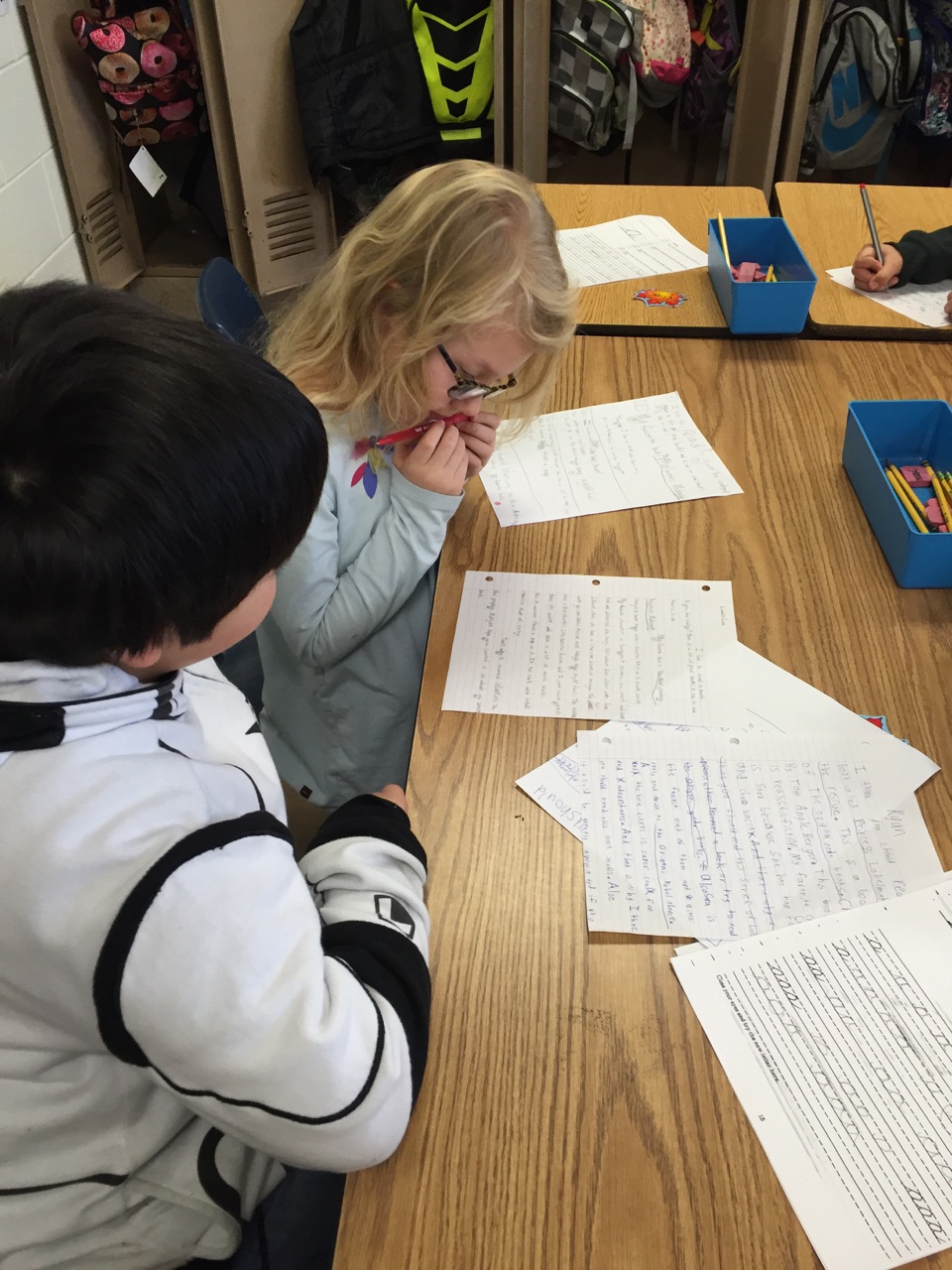
Students research Martin Luther King, Jr. in groups and compare notes.


Math

Comparing fractions. Students should know that
- When the numerator is 0, the fraction is equal to zero.
- When the numerator and denominator are the same, the fraction is equal to one.
- When the denominators are the same, but the numerators are different, the larger numerator is the larger fraction. Students need to understand that this is because they are getting more equal pieces of the same whole.
- When the numerators are the same, but the denominators are different, the larger denominator is the smaller fraction. Students need to know that the smaller denominator represents fewer, but larger equal groups.

Students are learning to simplify fractions using 2/2, 3/3, and 5/5.

Science


We continued our study of renewable and non-renewable resources by creating a model of an oil spill and attempting to clean it up. I'm thrilled that several students repeated this exercise at home. The goal of the lesson is to have them understand the pros and cons of different energy sources,.

Important Dates and Reminders

I will highlight new and changed dates on subsequent posts in red.

Lego Star Wars figures are VERY popular right now. I am implementing a NO TRADE rule to eliminate disagreements over trades and trade-backs. Obviously, students are free to do what they like outside of school. 

January 27 - Early Dismissal Professional Development 1pm

February 1 through 16 - Ohio Wildlife Center donation drive
February 15 - No School Presidents' Day


February 16 - Ohio Wildlife Center Visit

The Ohio Wildlife Center (OWC) will visit us to celebrate Valentine's Day. We are going to collect donations to "pay" for their visit. The OWC will bring several indigenous animals (e.g., opossums, turtles, snakes, bats, hawks, owls, etc.) to share with our 3rd graders.  Please consider donating to help us continue to bring this great opportunity to Windermere. Students should bring their donations to school on Friday, February 12th. We don't have much room for storing donations prior to that day. Please click on the list below to see what items the OWC needs. Priority items are in yellow. Thank you in advance for your support. 


Many students still like to exchange Valentine's Day cards. Students may bring Valentine's cards. They should not bring any candy to exchange per district policy. I also recommend signing cards, but not addressing. This makes it much faster to hand out cards. 

March 2 - Early Dismissal Professional Development 1pm
March 18 - End of Third Quarter
March 21 through 25 - No School Spring Break
March 28 - No School Teacher Grading Day

April 6 - Early Dismissal Professional Development 1pm
April 12 and 13 - Ohio English Language Arts Assessment
April 20 and 21 - Ohio Mathematics Assessment

May 27 - Last Day of School for Students

Friday, January 22, 2016

Newsletter for January 22, 2016

What We Learned This Week

Word Study


The class is split between the Within Word and Syllable Juncture stages. Within Word students are studying long and short e patterns, specifically vowel teams of ee and ea. Syllable Juncture students are studying compound words.

We are continuing our cursive practice and have introduced lowercase l, h, k, b, f, and e.

Students are practicing keyboarding and have learned correct finger assignments for a through u. The class generates a great amount of writing by hand, but writes much less when typing because it's so labor intensive. We only spend a few minutes on this daily, but I am really hoping it will pay off for them.

We are learning action and being/linking verbs. Being/linking verbs (e.g., is, am, are, etc.) are somewhat tricky for most students so we will probably spend some more time on them.

Reading Workshop & Writing Workshop 


We are continuing our African American research unit. I began by giving the entire class one minute to brainstorm famous African Americans, people who have made significant contributions or firsts. After eliminating contemporary entertainers and athletes, the class came up with five: President Barack Obama, Dr. Martin Luther King, Rosa Parks, George Washington Carver, and Jackie Robinson. When I repeated the exercise for famous white Americans, the class generated a huge list including political leaders, artists, and scientists. The discrepancy between the two lists was very impactful for many students.

To learn research skills and build awareness of the contributions of African Americans, I will model the research process with Rosa Parks; students will study and report on Dr. Martin Luther King in groups; and students will work independently on an individual African American. I model with Rosa Parks and Dr. King because the students typically already have some solid background knowledge on them.

I am still modeling research strategies on Rosa Parks. As we read, we look for "noteworthy" facts, which we write on note cards in our own words and then write an abbreviated citation. Later, we will organize these cards to compose our report. I have shared that these strategies can be used for any topic. However, as we approach Black History Month, we will be studying famous African Americans. We are using three texts with different text levels.


We celebrated Dr. Martin Luther King, Jr. Day by watching two videos (see below) and discussing his sacrifice and contribution to the Civil Rights Movement. 

Click on Kid President to be inspired to persevere and serve others for equality.

Click on Dr. King to learn a bit about his life's work.

We finished Out of My Mind, by Sharon Draper, and have started a new genre, fantasy. We are reading The Lion, The Witch, and The Wardrobe by C. S. Lewis.


Math Workshop


We continue to study fractions. Students should be able to identify and explain numerator and denominator, determine fractions of whole numbers in story problems (e.g., If 3/4 of 24 students have freckles, how many students have freckles), identify fractions in arrays, identify fractions as equal groups, put fractions on a number line, identify fractions on a number line, and convert irregular fractions (numerator > denominator) to mixed number fractions.

Fractions are the single most complex content strand in mathematics in third grade and great motivation for sharpening those math facts. We will likely work on fractions through February.

Important Dates and Reminders

I will highlight new and changed dates on subsequent posts in red.

January 27 - Early Dismissal Professional Development 1pm

February 1 through 16 - Ohio Wildlife Center donation drive
February 15 - No School Presidents' Day


February 16 - Ohio Wildlife Center Visit

The Ohio Wildlife Center (OWC) will visit us to celebrate Valentine's Day. We are going to collect donations to "pay" for their visit. The OWC will bring several indigenous animals (e.g., opossums, turtles, snakes, bats, hawks, owls, etc.) to share with our 3rd graders.  Please consider donating to help us continue to bring this great opportunity to Windermere. Students should bring their donations to school on Friday, February 12th. We don't have much room for storing donations prior to that day. Please click on the list below to see what items the OWC needs. Priority items are in yellow. Thank you in advance for your support. 


Many students still like to exchange Valentine's Day cards. Students may bring Valentine's cards. They should not bring any candy to exchange per district policy. I also recommend signing cards, but not addressing. This makes it much faster to hand out cards. 

March 2 - Early Dismissal Professional Development 1pm
March 18 - End of Third Quarter
March 21 through 25 - No School Spring Break
March 28 - No School Teacher Grading Day

April 6 - Early Dismissal Professional Development 1pm
April 12 and 13 - Ohio English Language Arts Assessment
April 20 and 21 - Ohio Mathematics Assessment

May 27 - Last Day of School for Students

Friday, January 8, 2016

Newsletter for January 8, 2016

What We Learned This Week

Word Study

Students reviewed the short u, closed syllable pattern (VC/VCC) in words like truck and mud. Introduced a new sound, oo (e.g., moo), and we studied two common spelling patterns: ew (e.g., drew) and ue (e.g., clue). We had several good oddballs this week. Sew is an oddball because its ew pattern makes a long o sound instead of the oo sound; do is an oddball because it makes the oo sound, yet is spelled with only an o; and truth, a closed syllable, is an oddball because it should make a short u sound, but makes the oo sound.


Students sort using anchor words. The first strategy is to use sight (look for VC closed syllable words, CVV ew and ue words. The second strategy is to say and "stretch" each word to listen for oddballs, syllables that do not follow the rules and generalizations we are focusing on.


Finally, students spent time looking for ew and ue words in their reading. 

Students practiced their cursive letters based on the lower-case i shape: i, u, w, t, j, p, r, and s.

I'm pleased with the students' keyboarding familiarity. We spend less than five minutes on this daily and add one letter per day. Students are getting comfortable with the home row and correct finger assignments. This should be a very useful skill as they are required to compose more on the computer, especially next year with our device roll-out.

Students learned how to make nouns possessive. They should know that if the noun ends in s they simply add an apostrophe, but if it does not end in s they should add an apostrophe s. We reviewed common, proper, singular and plural nouns as well.

Reading

We focused on making predictions based on evidence. Students also started the challenging process of summarizing non-fiction/informational texts. This is an important step in developing research skills. Students are directed to pay close attention to non-fiction/informational text features (table of contents, glossary, index, text boxes, graphs, charts, maps, etc.). Students should know to read the text first and then support their understanding using text features. Students are recording the main idea and supporting details on index cards in their own words. The next step will be to organize the cards into paragraphs and write a summary. I will use this experience to model researching biographies.

Writing

Students received their pen pal letters from England this week. Many of our pen pals wrote in cursive, which was great practice for applying our cursive knowledge. We also composed our Friday Thank You's. Most of this week's writing was modeled while summarizing non-fiction/informational texts.

Math

I reviewed multi-digit multiplication using the partial products and traditional regrouping algorithms. Students should be able to multiply and divide within 100 (know their basic facts). Basic fact fluency is a key skill that must be mastered this year. Progress reports will reflects which students need to practice these facts nightly.

I introduced fractions and applying them to story problems. Students should know the denominator is their starting point in any fraction problem. I call the denominator their "best friend" as it is so important to solving fractions. Students should know the denominator represents the number of equal groups/shares, but is not the number of unites/pieces/parts in the whole. The numerator is the number of equal groups/shares we are considering out of our total/whole. We are solving complex problems using either groups or fact fluency. Here is an example problem.

I have 24 cookies. 3/8 of my cookies are snickerdoodles. 2/6 of my cookies are peanut butter. The rest are samoas. How many samoas do I have?

Groups: D
- Draw 8 circles/groups of snickerdoodles to represent the denominator.
- Fill in each group with 3 to represent the units.
- Circle 3 of the groups to represent the numerator.
- Sum the 3 groups circled to find that 9 cookies are snickerdoodles.

- Draw 6 circles/groups  of peanut butter cookies to represent the denominator.
- Fill in each group with 4 to represent the units.
- Circle 2 of the groups to represent the numerator.
- Sum the 2 groups circled to find that 8 cookies are peanut butter cookies.

- Sum the snickerdoodles and peanut butter cookies (9 + 8 = 17).
- Find the difference between the non-samoas and the total cookies (24 - 17 = 7 samoas).

Not too shabby for 3rd grade!

I have also started to emphasize the zero, the whole/the one, and 1/2 (and fractions equivalent to 1/2).


Schoology

To register for Schoology as a Parent: 1. Go to www.schoology.com/register and click on the “Parent” button. 2. Enter your access code. 3. Fill out the form with your information. 4. Click “Enter” to submit your information and complete your registration. 5. To associate additional students to your account, click the “Add Child” button in your Schoology account. 6. Log out of Schoology and then log back in. Your user name will be your email address. Your password will be what you set it to. Please note - parents will login to Schoology at schoology.com. Students will login at uaschools.schoology.com. 7. In the upper right hand corner of the screen you should see "All Children." This is a drop down menu that will allow you to toggle between your children's accounts. If you have questions please contact: familytechhelp@uaschools.org

Music

Eric "The Fish" Paton brought his Brazilian percussion expertise to Windermere as our artist in residence this week. I hope your student enjoyed learning and playing percussion.


Important Dates and Reminders


Apparently, there is a football game this weekend:)

I will highlight new and changed dates on subsequent posts in red.

January 11 - No School Teacher Grading Day
January 18  - No School Martin Luther King Day
January 19 - Progress reports sent home
January 21 - Conferences, Early Dismissal at 11:05, NO LUNCH SERVICE
January 27 - Early Dismissal Professional Development 1pm

February 1 through 16 - Ohio Wildlife Center donation drive
February 15 - No School Presidents' Day
February 16 - Ohio Wildlife Center Visit

March 2 - Early Dismissal Professional Development 1pm
March 18 - End of Third Quarter
March 21 through 25 - No School Spring Break
March 28 - No School Teacher Grading Day

April 6 - Early Dismissal Professional Development 1pm
April 12 and 13 - Ohio English Language Arts Assessment
April 20 and 21 - Ohio Mathematics Assessment

May 27 - Last Day of School for Students

Friday, December 11, 2015

Newsletter for December 11, 2015

Dear Families,

This year is flying by! I can't believe we only have two weeks left in this grading period. I will be assessing students next week in reading and mathematics prior to break. Please let me know if your student will be leaving early for break.

I hope everyone has a relaxing and safe holiday. There will not be a newsletter next week.

What We Learned This Week

Word Study

We started learning our cursive. I will emphasize lower-case and reading, once we have gone through all of the lower-case letter forms. Students are encouraged to trace the shape (bottom-up), use a relaxed grip (many students grip the pencil too hard as they are concentrating and it hurts their hand and their handwriting also suffers), use a good posture with feet on the floor, tilt their paper to get a nice slant, circle their best cursive letter on each line (it's helpful to notice differences in letters), and attend to letter connections (how letters are built off of each other, e.g., the c shape is the basis for the a, d, g and q shapes).

In the spirit of the district's 1:1 plan for student devices, I handed out my very "expensive and fragile" laminated keyboards. Keyboarding is such an important skill that I am spending a few minutes each day familiarizing students with where the letters are on the keyboard and proper finger-key assignments.


We are concluding our noun study. Students are have learned the differences between proper and common nouns and singular and plural nouns. We know most singular nouns can simply add an -s to make them plural (e.g., key keys) and if we add a syllable, we need to add -es to make them plural (e.g., lunch lunches).

Reading Workshop

Students are developing their ability to use context clues to decode and, more importantly, comprehend unfamiliar words. We do this using short passages with missing or made up (ala Seuss) words.

Writing Workshop 

We are writing (and will publish next week) our pen pal letters. Students are telling a bit about themselves, what they plan to do over winter break and are recommending a book to their pen pals. We will email these to make sure our pen pals receive them before they go on break. We are spending a lot of time on planning, drafting and rereading. Students use simple rubrics to ensure they have all of the important parts of each paragraph and reread their work with partners. "Debates" make these authentic writings even more important to the students and they are giving great effort.


Science

Who knew dirt was so fun!? We started our classroom garden. We are going to try to grow carrots, spinach, pumpkins, catnip, chamomile and lavender.


I don't know if we will see any snow this year, but in anticipation of winter break, I wanted to go ahead and share my snow day homework. If we do have a snow day and students are asked to do homework, my plan is to have them log on to the following website, choose a science experiment, attempt it and send me a photo of them doing it. You may want to try some of these over break if you're looking for something to do or get cabin fever (if it ever gets cold). Have fun!


Math Workshop

I will assess students understanding of multiplication on Monday of next week. I will mark the assessments and return them so they can attempt to correct any operational errors. Students should be able to:
- Represent addition of same sized groups as multiplication: 3 + 3 + 3 + 3 = 4 x 3 (or 4 groups of 3)
- Represent multiplication as an array or area model (and vice versa)
- Rewrite one and two step story problems as equations and solve.
- Use rounding to estimate products.
- Solve equations using multiples of ten by recognizing the base facts.
- Apply the associative, commutative, and distributive properties to multiplication statements.
- Fill in the blanks in a multiplication chart (number of groups, amount in each group, total).
- Identify the number of ones, tens and hundreds in a three digit number.


Not many students seem to have jumped on the Front Row Math website. If you would like to try a different one, you can try out the much lauded Khan Academy. To make an account and get started, log in to https://www.khanacademy.org/


Important Dates and Reminders

I will highlight new and changed dates on subsequent posts in red.

Please visit the holiday party sign-up. Thank you room parents for all of your hard work!
http://www.signupgenius.com/go/10c0a4fa9af2ea02-3rdgrade

December 21 through January 1 - Winter Break

January 8 - End of Second Quarter
January 11 - No School Teacher Grading Day
January 18  - No School Martin Luther King Day
January 21 - Conferences, Early Dismissal at 11:05, NO LUNCH SERVICE
January 27 - Early Dismissal Professional Development 1pm

February 1 through 16 - Ohio Wildlife Center donation drive
February 15 - No School Presidents' Day
February 16 - Ohio Wildlife Center Visit

March 2 - Early Dismissal Professional Development 1pm
March 18 - End of Third Quarter
March 21 through 25 - No School Spring Break
March 28 - No School Teacher Grading Day

April 6 - Early Dismissal Professional Development 1pm
April 12 and 13 - Ohio English Language Arts Assessment
April 20 and 21 - Ohio Mathematics Assessment

May 27 - Last Day of School for Students

Saturday, December 5, 2015

Newsletter for December 4, 2015

What We Learned This Week

Word Study
I assessed and sent home this week's word study assessment over long and short o patterns and contractions. Students expanded their long o patterns to include VCC patterns. This can be very confusing. Up till now, all VC/VCC patterns have represented closed syllables and produced short vowel sounds (e.g., clock, mop). Students are now learning long o VCC words (e.g., ghost, post).

Reading Workshop
Students took the Ohio 3rd Grade English Language Arts Assessment (AIR) this week.

Students are meeting with me one-to-one for reading conferences where I am assessing their ability to choose appropriately leveled texts, introducing them to new genres, observing and modeling decoding skills (e.g., sounding out, applying word study patterns, using context clues), and discussing their reading for comprehension (including basic 5 W's and higher level connections, predictions, inferring, etc.).

Writing Workshop
We received our pen pal letters with much excitement. These letters provided rich material for discussion and learning. We are expanding our introductions and conclusions beyond a single sentence. We will be sharing what we plan to do over winter holiday, recommending favorite books and responding to pen pals' letters.

Math
As most of the class has mastered the partial products algorithm, we are moving on to the traditional algorithm (the way most adults learned multi-digit multiplication). With a strong understanding of partial products, we can explain the traditional algorithm, rather than just memorizing steps to solving a problem without any understanding of what we are doing.

Partial Products example

                 452
               x    5
                   10  5 x 2 = 10
                 250  5 x 50 = 250
               2000  5 x 400 = 2000
               2260

Note that students are asked to write each partial products equation to the right of the products and underline the basic (single digit) fact in each. Students' understanding of expanded form and the distributive property are relied on heavily.

Traditional Algorithm example

                 2 1
                 452
               x    5
               2260

Note the ten and two hundred from the above partial products are "carried" to their respective place value columns.

Science
We are concluding our life science unit with the game Into The Forest. This award winning card game teaches students the importance of the different roles in an ecosystem (decomposers, producers, consumers) and how they are interdependent. I also enjoy games because they develop problem solving and strategic thinking.

 
Upper Arlington Rotary Visit
Windermere parent and Upper Arlington Rotary president, Mr. Bill Cloyd, visited our class to inspire and educate. Students learned about the challenges young students in Guatemala have overcome and how the Rotary has assisted them. We are hoping to partner with the UA Rotary to develop a service learning project.


Paul O. Zelinsky Visit
Caldecott winning author-illustrator, Paul O. Zelinsky, visited on Friday to talk about his craft.


Important Dates and Reminders

I will highlight new and changed dates on subsequent posts in red.

November 30 - December 10 - Student Council - Coat Drive. 

December 21 through January 1 - Winter Break

January 8 - End of Second Quarter
January 11 - No School Teacher Grading Day
January 18  - No School Martin Luther King Day
January 21 - Conferences, Early Dismissal at 11:05, NO LUNCH SERVICE
January 27 - Early Dismissal Professional Development 1pm

February 1 through 16 - Ohio Wildlife Center donation drive
February 15 - No School Presidents' Day
February 16 - Ohio Wildlife Center Visit

March 2 - Early Dismissal Professional Development 1pm
March 18 - End of Third Quarter
March 21 through 25 - No School Spring Break
March 28 - No School Teacher Grading Day

April 6 - Early Dismissal Professional Development 1pm
April 12 and 13 - Ohio English Language Arts Assessment
April 20 and 21 - Ohio Mathematics Assessment

May 27 - Last Day of School for Students