Showing posts with label science. Show all posts

Friday, September 5, 2014

Newsletter for September 5, 2014

Dear Families,

We love mustaches:)


What We Learned This Week

Word Study

Students learned four new vocabulary words (impatient, appropriate, appliance, and mumble). I look for any opportunity I can find to include and bring attention to these words throughout the week. It is rewarding when students find them in their reading and share. We also studied each word's part of speech (noun, verb, adjective). I introduced verb tenses (past, present, and future). We will study this in much greater detail later.

Reading


We studied cause and effect this week, an important comprehension skill. While students are initially thrown by the vocabulary, they begin to understand it as what happened first and what happened next, or what causes an effect. We used The Wump World by Bill Peet to explore cause and effect.


Writing Process

We began planning our first persuasive essay. To begin we learned the writing process and associated kinesthetic movements with each stage: planning, drafting, revising, editing and publishing. Planning consisted of two stages, identifying skills, traits and/or experiences that would make us good student council representatives. Then we recalled specific examples where we demonstrated each skill, trait, or experience. Students then started their drafts, persuading their peers to vote for them for student council.  

The Writing Process
(Click to View)

Math

We reviewed all of last week's concepts and began rounding to the nearest ten. We discussed why this is an important skill. Rounding allows us to quickly check more precise work. It also supports our ability to do mental math.

Science

We did our first theme rotation of science, social studies and health. In science we studied natural resources (naturally occurring resources from the Earth) and identified renewable resources (resources that can be replenished in our lifetime, e.g., fish, crops, trees, water, and solar, etc.) and non-renewable resources (resources that cannot be replenished in our lifetime, e.g., minerals and fossil fuels).

We talked about all of the ways we use minerals to understand their importance; energy, food, building, and money are just a few.

Click on images to enlarge.

Technology

The 3rd Grade team shared many of the technology skills and standards third graders will need to master this year. Here is a link to a great summary of all the skills they will learn. Any at home practice will be very beneficial.
Please see the homework post for keyboarding practice sites
Adults Working With Your Student

We have many talented professionals working with different members of our classroom community. I wanted to provide you with a face to go with the names you'll be hearing at home. Our First Education Experience Program (FEEP) student, Ms. Stevenson, will be joining us for some of our fall conferences. If you would prefer to only meet with licensed educators, please let me know. It will be very appreciated and beneficial to Ms. Stevenson if she can attend conferences.

Ms. Das
Intervention

Ms. Dible 
Assistant Teacher

Ms. Gaffney
Intervention

Ms. Knight
Interpreter

(Picture coming)
Ms. Mayhan
Occupational Therapist

Ms. Porteus
Reading/Writing

Ms. Robeson
Paraprofessional

Ms. Savage
Deaf & Hard of Hearing Teacher

Ms. Starling
Orton Gillingham

Ms. Stevenson
Ohio State FEEP Student

Ms. Uchida
Speech

Ms. Westlake
Interpreter

Important Dates and Reminders

Please make sure your student wears gym shoes on B and E days.

Fall conferences will be the second week of November. Please visit the signup genius page to choose your date and time by clicking on this link.


Important 1st Quarter Dates & Reminders

New dates and times are indicated in red. 

September 2 through 26, 2014 - STAR Reading and Math Diagnostic Testing
September 9, 2014 - PTO General Meeting at 7pm (See PTO website for future meetings)
September 10, 2014 - Early Dismissal/Teacher Development at 1pm
September 12, 2014 - Thompson Park Tree Trek Field Trip
September 19, 2014 - Black and Gold Day: Show your support for UA's homecoming
September 22 through 26, 2014 - PTO Book Sale
September 26, 2014 - Wacky hair day
September 26, 2014 - Fall Family Fun Night from 5 till 7pm

October 3, 2014 - Hat day
October 6 through 10, 2014 - Hawk Walk for the Playground
October 8, 2014 - Ohio Reading Achievement Assessment (Please avoid scheduling absences on this date)
October 10, 2014 - Blue and Green Day: Show your Windermere Hawk Pride
October 13 through 17, 2014 - Collection days for Box Tops for Education
October 17, 2014 - Blue and Green Day: Show your Windermere Hawk Pride
October 17, 2014- Field Trip to Thompson Park (please email if you would like to volunteer)
October 23, 2014 - Fall picture retakes
October 24, 2014 - End of the first quarter
October 27, 2014 - No school, teacher grading day

Important 2nd Quarter Dates & Reminders

October 30, 2014 - UA Trick or Treating from 5:30 till 8pm
October 31, 2014 - Halloween party (extended lunch from 12 till 1:30pm, most students go home to change into costumes)

November 3 through 7, 2014 - First quarter conferences
November 4, 2014 - No School for Students, Teacher Development Day
November 5, 2014 - Progress Reports sent home
November 6, 2014 - Early Dismissal/Conferences at 11am
November 10 through 13, 2014 - Fall conferences
November 17 through 21, 2014 - District Gifted Screening
November 25, 2014 - Scarlet and Gray Day
November 26 through 28, 2014 - No School Thanksgiving

December 1 through January 9, 2015 - STAR Reading and Math Diagnostic Testing
December 3, 2014 - Early Dismissal/Teacher Development at 1pm
December 19, 2014 - Holiday parties 2pm
December 22 through January 2, 2015 - No School Winter Break

January 16, 2015 - End of second quarter
January 19, 2015 - No School Martin Luther King, Jr. Day
January 20, 2015 - No school, teacher grading day

Important 3rd Quarter Dates & Reminders

January 27, 2015 - Progress Reports sent home
January 29, 2015 - Early Dismissal/Conferences at 11am

February 2 through 13, 2015 - Ohio Wildlife Center donation drive
February 4, 2015 - Early Dismissal/Teacher Development at 1pm
February 9 through 13, 2015 - Collection days for Box Tops for Education
February 16, 2015 - No School Presidents' Day
February 17, 2015 - Math State PBA
February 23, 2015 - English Language Arts State PBA
February 23, 2015 - AASCD

March 9 through 13, 2015 - PTO Book Sale
March 17, 2015 - 3rd Grade Musical
March 20 through 27, 2015 - No School Spring Break

April 2, 2015 - End of third quarter
April 3, 2015 - No School
April 6, 2015 - No School, teacher grading day

Important 4th Quarter Dates & Reminders

April 8, 2015 - Early Dismissal/Teacher Development at 1pm
April 9, 2015 - Spring Picture Day
April 13 through May 22, 2015 - District Writing Diagnostic Testing
April 14, 2015 - Progress Reports sent home
April 21 through 22, 2015 - English Language Arts State EOY
April 22, 2015 - Ohio Reading Achievement Assessment
April 24, 2015 - Kid Fest
April 28 through 29, 2015 - Math State EOY

May 1 through 29, 2015 - STAR Reading and Math Diagnostic Testing
May 9, 2015 - Wish Run
May 25, 2015 - No School Memorial Day

June 1, 2015 - Field Day
June 3, 2015 - End of fourth quarter/Last day for students, Classroom parties 12:05 till 1:05pm
June 9, 2015 - Progress Reports sent home

Saturday, August 24, 2013

Newsletter for August 23, 2013

Important Dates & Reminders

*I will try to highlight new dates and information with red text.

August 29, 2013 - Parent Information Night from 7:45pm till 8:30pm. The third grade team will be presenting together in Dr. Myers' Art Room, Room 126. Please note the change in time and location. You can sign up for fall conferences in the hallway.

September 2, 2013 - No School in honor of Labor Day

September 6, 2013 - Walking field trip to Thompson Park. More information will be shared during Parent Information Night. This field trip will support our life science, technology and service learning curricula. We will leave Windermere at 9:00am and return in time for lunch at 11:25. If you are available to chaperon, please email me. I would like to have at least seven adults.

September 11, 2013 - Early Dismissal for professional development at 1:15pm

October 8, 2013 - Ohio Reading Achievement Assessment (Please avoid scheduling appointments and absences on this date)

October 25, 2013 - End of the first quarter

October 28, 2013 - No school, teacher grading day

October 31, 2013 - Halloween party (extended lunch from 12pm till 1:30pm, most students go home to change into costumes)

What We Learned This Week

What a wonderful first week. I'm very fortunate to get to work with such a special group of students. Too, with only nineteen students I feel I've already gotten to know them much faster. We spent a lot of time this week establishing community routines and expectations. We will continue to reinforce these norms as the foundation for a learning community in the weeks to come. My emphasis will always be on catching students making good choices.

Word Study
I introduced syllables this week. Our understanding of syllables is that they represent one vowel sound, often made from multiple vowels. We practiced breaking multi syllabic and nonsense words into their syllables by saying the word, clapping the word and then writing the word. Students noticed that syllables ending in vowels usually make a long vowel sound (e.g. go) and syllables ending in consonants usually make short vowel sounds (e.g. can). The benefit of recognizing syllables and syllable types is twofold: decoding (reading unfamiliar words) and encoding (spelling words in our spoken vocabulary that we have not written before or have only used inventive spelling for). This requires a systematic review (and in some cases, introduction) to vowels and vowel sounds as well as consonants. We will do an intensive study of syllable types this year. I won't begin sending home spelling lists till the first week of September. These lists will represent the syllable type, vowel, or consonant spelling generalization we are studying that week. Students will be assessed with new words that represent the generalization we are studying. This will better represent their application than memorization of specific words. I'll discuss this in more depth at Parent Information Night.

Reading
I began individual reading conferences this week with an emphasis on choosing a just right book. It is important for young readers to have some choice in much of what they read to develop their interest and enjoyment of reading. However, it is equally, if not more, important that they be reading "just right books," (JRB) books they can read independently (a book they can read with 98% accuracy). What we may consider to be "easy" books are the perfect material for young readers and with access to libraries and the Internet students have access to JRB that are about their interests or are from their favorite genres.

Building reading stamina and self awareness of being a "real reader" (a committed reader that is focused and engaged) was a priority this week and we will extend our independent reading time up to an hour eventually (this will take some time). I will use this time daily to meet with individuals for reading conferences and word study intervention.

Reading homework focuses on two areas: reading non-fiction texts for information and comprehension. The first side supports students ability to read text for detail, a key skill in all future self directed learning. The back, optional this week, supports students ability to recall, synthesize and deeply comprehend what they are reading, all higher order reading skills. The back will not be optional beginning next week. Students, and families, desiring additional reading homework should encourage their student to read aloud nightly for approximately 20 to 30 minutes. Again, choosing a JRB is key.

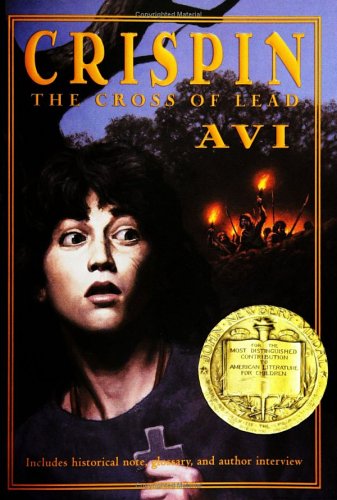
Our first read aloud is Crispin: The Cross of Lead, by Avi. We will read several Avi books representing a timeline of events from the Middle Ages till the 1940's. This historical span will support our social studies curriculum, specifically understanding changes in communities over time. We will also leverage Avi to study the author's craft as students will recognize reoccurring themes and techniques. If you'd like to read more about Avi, his website is http://www.avi-writer.com/index.html. A summary of Crispin is available at http://www.avi-writer.com/books/books/crispincross.html.

 
Our first read aloud.

Students are encouraged to ask questions to support their comprehension.

 
Writing
We recorded our first writing sample of the year by writing a personal narrative about an experience from the summer. I was very pleased with most students' content. These writings serve me in getting to know the class as writers and will provide an inspiration as we look back to them to see our growth as writers. Convention is always a focus in third grade. We began working on complete sentences and will work towards mastery before moving on to the writing process, paragraphs and multi-paragraphs. Complete sentences must:
- Begin with a capital letter.
- End with a punctuation.
- Contain (or an implied) who (noun, subject).
- Contain a what (verb, predicate).
Students wrote their own sentences and we examined them for the above requirements.

Math
Numeracy will be our focus for the first month of school. I will engage students who have mastered this with problem solving, math games and Number Talks (I plan to share more about this mental math development program). This week, we studied place and value, patterns, standard notation, expanded notation and naming numbers.

34,506
standard notation
 
30,000
4,000
500
00
6
expanded notation
 

Below students are lined up, each one with a value in a place from ones to one-hundred thousands. They must offer two names. For example a student who had written 2 an was standing in the tens place would say, "twenty or two tens." This is far more complex than we might expect. Click on the video to see students in action.

 
Click on the video to see students in action.
 
Below students are playing Biggest Number, a game where they take turns rolling a ten sided die and determining where they should record their roll (in one of the 6 possible places up to the hundred thousands). Students learn to leave higher places open for higher values and to record low values in low places. Students then read their numbers to each other at the end of each game, practicing this important skill. Students who struggle with reading large numbers are encouraged to "read three numbers (between the commas) just as you would read any number up the hundreds place and then give it a last name (thousands, represented by the comma) of thousand." Most third graders are comfortable reading numbers up to the hundreds and this makes this skill less overwhelming when reading numbers up to one-hundred thousands.
 
We studied the repeating pattern of ones, tens, hundreds, one-thousands, ten-thousands, hundred-thousands.


I also conducted a benchmark fact fluency assessment of students addition and subtraction skills. If your student has not mastered these yet, please work on them at home. While some students may need to memorize specific facts, I will attempt to anchor all math facts to a strategy (e.g., sums to ten ~ on the back of this week's math homework).


Science
I enjoy beginning the year with a science experience. I find science to be a great opportunity for students to fully engage in their learning. As it is hands on and experiential, it allows all students to fully participate and develop a love for learning regardless of possible literacy challenges. We pulled all three third grade classes to introduce our physical science of force and motion. We also explored solids, liquids and gases as we added water to Alka-Seltzer to create a gas. We then went outside to launch or film canister rockets. On Tuesday, we had very little success (The bag of Alka-Seltzer had apparently gotten enough moisture in it to release the gas, but it maintained is solid state, thus it did not create enough gas to launch our rockets by building up sufficient pressure to pop the lids off.). This provided us with a wonderful learning opportunity to hypothesize, based on what we expected to happen, why the rockets failed. Having predicted the cause as a group, we tried fresh Alka-Seltzer the following day with much success. We also used a leaf blower to demonstrate Bernoulli's principle, that when air flows around an object (like an airplane wing) it speeds up creating an area of low pressure. We were able to suspend a ball over the flow of air because of the high pressure below and on the sides as gravity pushed down. We will expand on this unit in the spring.


To see Bernoulli's principle demonstrated, click on the following link: http://science.discovery.com/tv-shows/head-rush/videos/head-rush-leaf-blower-ball.htm

We also planted our classroom garden of carrots, chamomile, spearmint, oregano and basil. In conjunction with our Social Studies study of the feudal and agrarian systems of the Middle Ages, we planted like our early ancestors. We will observe changes and compare and contrast the plants we grow until we can collect them and celebrate our garden with a small meal featuring our harvest. We watched a short brainpop video on seed plants.


Social Studies
We began studying the Middle Ages, specifically the feudal system to see an earlier and contrasting form of self government from our democratic system. I will elaborate on this as the year progresses and we study other forms of government through Avi's books and our government unit on the three branches and local government.